Increasing rural business activity was discussed in the Menzelinsky District.
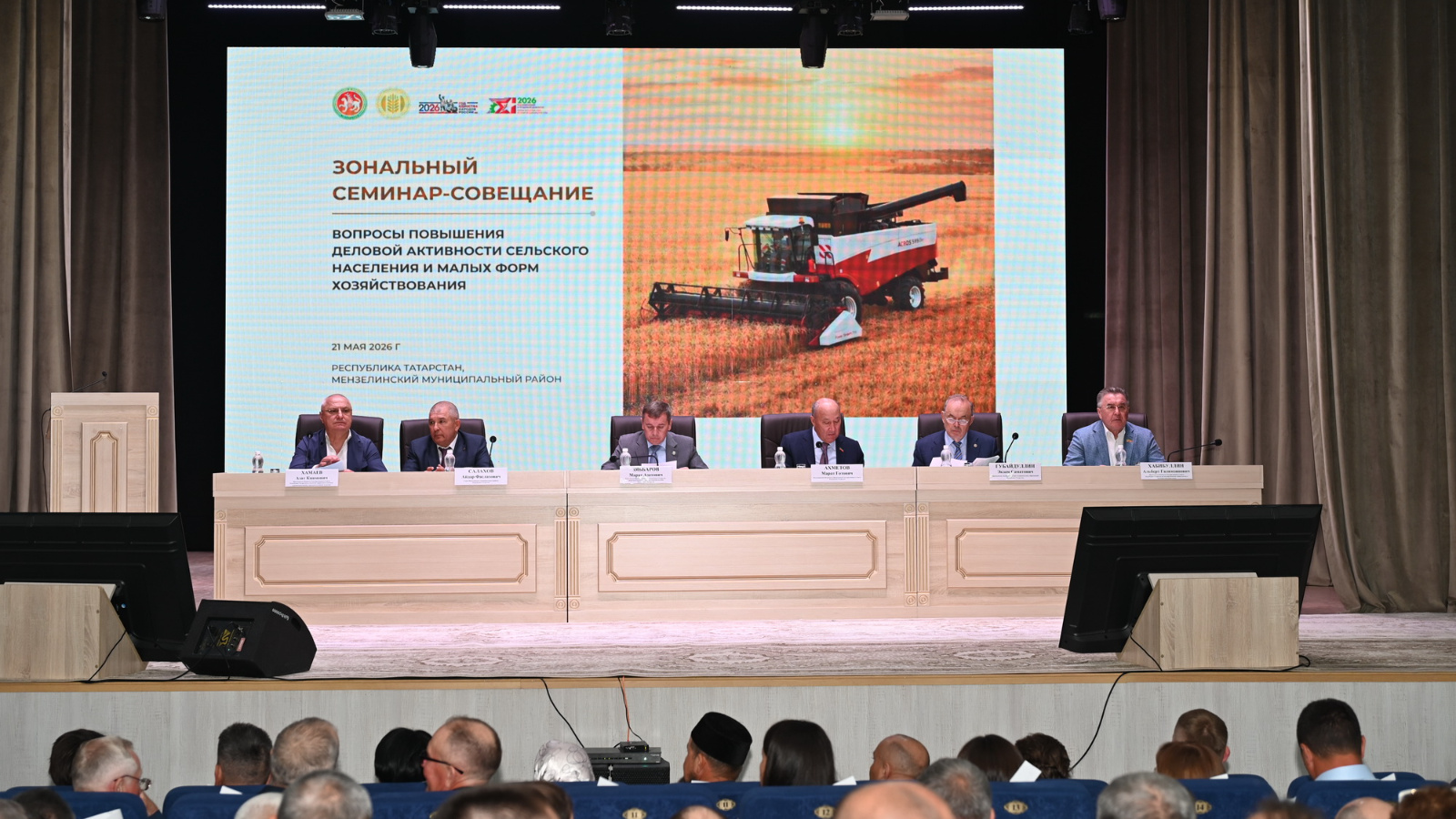
Today, a regional seminar-meeting on increasing rural business activity was held in the Menzelinsky Municipal District of the Republic of Tatarstan. Acting Chairman of the State Council of the Republic of Tatarstan Marat Akhmetov, Deputy Prime Minister of the Republic of Tatarstan – Minister of Agriculture and Food of the Republic of Tatarstan Marat Zyabbarov, Chairman of the Council of the Association of Local Governments of the Republic of Tatarstan Ekzam Gubaydullin, and State Council deputies Albert Khabibullin, Azat Khamayev, and Nazip Khazipov participated.
The heads of the Agryz, Aznakayevo, Aktanysh, Almetyevsk, Bavlinsky, Bugulma, Yelabuga, Leninogorsk, Mendeleyevsky, Menzelinsky, Muslyumovsky, Sarmanovsky, Tukaevsky, and Yutazinsky municipal districts, heads of rural settlements, heads of the Departments of Agriculture and Food, heads of private farms, peasant farms, and cooperatives also participated.
During the working visit, the participants visited the Kamsky Bacon dairy complex with a capacity of 19,625 head, the Menzelinsk-Broiler slaughterhouse, and the Kuzembetevsky RMZ.
The Kamsky Bacon dairy complex is actively implementing new technologies, particularly machine vision, which uses optical sensors and neural networks to automatically analyze images. This allows computers and equipment to "see," recognize defects, read markings, and control processes with virtually no human intervention.
The Menzelinsk-Broiler SSSPK facility was built five years ago under the "Slaughterhouse Construction" program, with a grant amounting to over 27 million rubles. Last year, 150.3 tons of poultry meat were produced there.
The Kuzembetevsky Repair and Mechanical Plant manufactures grain cleaning machines, seed and feed drying and ventilation equipment, and also builds and reconstructs grain cleaning plants and grain cleaning and drying complexes. The plant also repairs diesel engines. Its main focus is the production and sale of equipment for post-harvest grain handling and storage. Last year, 387 units of equipment were manufactured, and 150 diesel engines were repaired.
Marat Akhmetov then greeted the participants at the plenary session of the seminar-meeting at the Menzelinsk District Palace of Culture on behalf of the Rais of Tatarstan, Rustam Minnikhanov, the government, and the parliament of the republic. The acting speaker of parliament emphasized that the main goal of such meetings is to address the important task set by the Rais of the Republic of Tatarstan: increasing the business and social activity of the rural population. "The republic places great emphasis on preserving the rural way of life and developing rural businesses. The Rais of the Republic has repeatedly addressed this in his Annual Address to the State Council, at congresses of municipalities, and meetings with agricultural enterprise leaders. Rustam Minnikhanov personally oversees the situation in agriculture," Marat Akhmetov emphasized.
Marat Akhmetov discussed the key indicators of the republic's socioeconomic development. In terms of gross agricultural output, which exceeded 400 billion rubles for the first time in 2025, the republic ranks first in the Volga Federal District and fourth nationally. Total agricultural output, including private household plots, exceeded 800 billion rubles. Last year, small farms produced 160.5 billion rubles of gross agricultural output, accounting for 40% of the republic's total. "This is a tremendous effort, including by rural workers and everyone involved in rural life," noted Marat Akhmetov. He expressed gratitude to agricultural workers for their tireless work and significant contribution to the development of Tatarstan's agro-industrial complex.
Despite clear successes, according to Marat Akhmetov, the agro-industrial complex also faces challenges. "The situation is challenging. Today, the industry is going through a difficult period in terms of efficiency: grain procurement prices have been frozen at 2020 levels. Milk prices are a particular concern. Unlike neighboring regions—the Ulyanovsk and Samara regions, and Mari El—which produce around 300 tons of milk per day, our republic produces only 5,500 tons. The republic is the country's leader in gross milk yield. Due to low purchasing prices, our producers are losing over one and a half billion rubles in revenue every month. This is a very serious problem, and finding a solution to it is difficult even within the scope of a single republic. However, the republic's leadership understands and expresses concern about this issue," the Acting Chairman of the State Council emphasized.
According to Marat Akhmetov, agricultural development is not only a matter of rural employment.
but also the preservation of the rural way of life, and therefore, traditions, culture, and native languages, since these are best preserved in rural areas. "Agriculture is undoubtedly a foundation, a crucial industry, on whose condition the future of the village itself depends. But at the same time, rural life is not limited to agriculture alone, so all government agencies must be involved in increasing business activity in rural areas," he emphasized.
Addressing the heads of districts and rural settlements, Marat Akhmetov urged them to seek new forms of engagement with young people, more actively attract investors, and inform people about government support measures being implemented in the republic.
"Yes, these are difficult times, but I am confident that after the end of the special operation, we will return to these issues again. We need more ambitious rural development programs, including at the federal level," Marat Akhmetov believes. "Our vast country should not be confined to its cities."
Marat Zyabbarov reported on the progress of the sowing campaign in the Republic of Tatarstan. Spring crop sowing is entering its final stages, with 1,320,000 hectares (77% of the planned area) sown to date. This includes grain crops sown on 630,000 hectares (81%), sugar beets (98%), sunflowers (85%), and rapeseed (79%), along with 2,793 hectares of potatoes and vegetables.
During his speech, the minister outlined government support measures and noted, "The most effective form of support is the construction of mini-farms. Despite the overall decline in livestock numbers across the republic, the livestock of participants in the mini-farm construction program over the past six years has increased by 4,214 cows."
He cited the example of Marsel Kabirov's mini-farm in the Menzelinsky District. "With five cows, he has committed to increasing the herd to 10 cows." "He currently has 28 head of cattle, including 12 cows. Last year, he sold 444 centners of milk and 20 centners of meat for a total of 2.3 million rubles," he said.
Marat Zyabbarov also reported on changes to the grant support conditions for new and existing peasant farms—they have been combined into a single program. An "Agromotivator" grant for starting their own agribusiness, with grants of up to 7 million rubles, has been introduced for participants in the special military operation. Competitions for both categories are open from May 9 to June 8.
The minister emphasized that rural tourism is actively developing in the republic. There are already over 60 entrepreneurs in Tatarstan, 14 of whom have received grants from the Russian Ministry of Agriculture totaling 114 million rubles, including two this year totaling 15 million rubles.
Marat Zyabbarov added that last year, with the support of Raisa, the one-time payment for young specialists was increased to 750,000 rubles, which allowed the number of graduates to be doubled in rural areas. "However, a number of districts do not benefit from this support. This year, we set a goal of attracting 200 graduates," he said.
According to him, the federal project "Personnel in the Agro-Industrial Complex" of the national project "Technological Support for Food Security" will be implemented starting in 2025. Last year, 20 agricultural classes were opened, and 36 more are planned for this year.
Summing up the seminar-meeting, Marat Akhmetov instructed district heads to conduct a detailed analysis of the state of business activity in rural areas and to pay greater attention to the occupancy of industrial parks. "Industrial parks also work to stimulate business activity among rural residents and create new jobs," Akhmetov noted. “The contribution of each district to the gross regional product is significant, and the overall success of the republic depends to a large extent on this.”