Development of Russian Halal Product Exports Discussed at KazanForum 2026
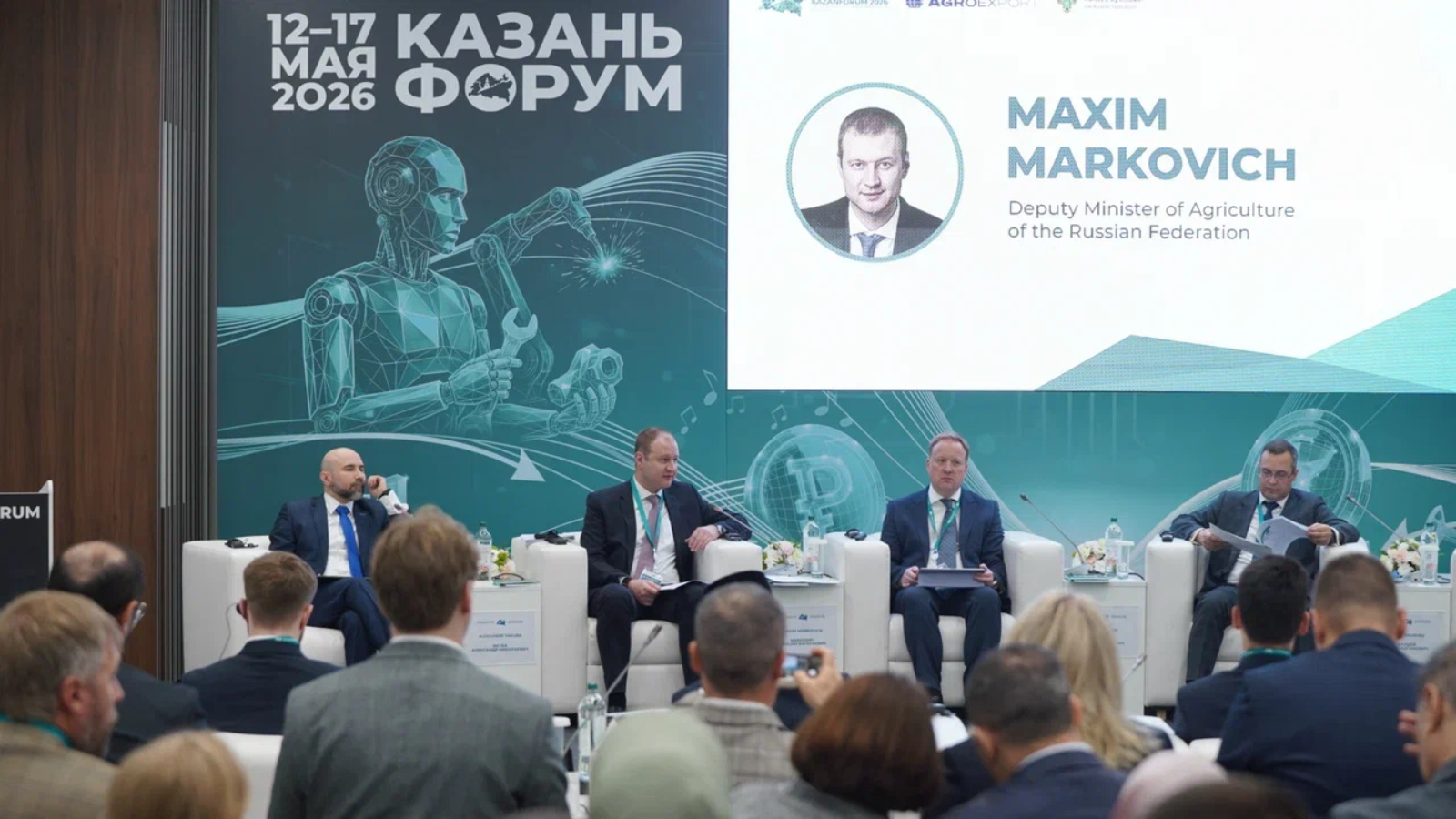
A panel discussion entitled "Export of Russian Halal Products: Impetus for Developing New Markets" was held as part of the 17th International Economic Forum "Russia – Islamic World: KazanForum." The discussion was moderated by Alexander Yakuba, Advisor to the Head of the Federal Center for Agroexport. Participants included Russian producers and exporters of agricultural products, foreign importers and distributors, investors, logistics providers, and certification bodies.
The platform served as a venue for direct dialogue between Russian producers and foreign importers, distributors, and investors to promote the qualitative growth of mutual trade, overcome barriers, and build long-term, sustainable supply chains.
Maxim Markovich, Deputy Minister of Agriculture of the Russian Federation, welcoming the session participants, noted that the forum has traditionally been a key platform for expanding Russia's cooperation with Islamic countries in many areas, including agriculture. This is confirmed by the significant number of foreign partners participating in the forum.
He noted: "Overall, expanding cooperation with Islamic countries is a priority for our country. Cooperation based on mutual respect and shared interests is particularly significant, demonstrating positive development trends. The halal market is currently one of the fastest-growing segments of the global food market, primarily due to the fact that population growth in Muslim countries is twice the global average. Overall, Russia's interaction with Muslim countries is multifaceted, and one of the most important areas is trade in agricultural products and food."
According to him, Russian halal exports will reach nearly $400 million in value by 2025. This is primarily due to the supply of meat products, confectionery, dairy products, and baby food.
Maxim Markovich added that the current geography of supplies covers approximately 20 countries, with Saudi Arabia, the United Arab Emirates, and Iran remaining key markets.
"Increasing the export of halal food products is one of the strategic areas of development for the Russian agro-industrial complex. Currently, seven certification centers are operating in Russia, issuing halal certificates of conformity for various products for export," the Deputy Minister said.
Ilya Ilyushin, head of the federal center "Agroexport," noted that the halal market is one of the fastest-growing segments of the global food market. "This is primarily due to the growing number of Muslims worldwide." "Currently, 25% of the world's population professes Islam, and this share is expected to increase to 35% in the coming years," he assured.
Ilya Ilyushin also presented a catalog of Russian companies exporting halal products.
Artem Daushev, Assistant to the Head of the Federal Service for Veterinary and Phytosanitary Surveillance of Russia, spoke about access for halal products to foreign markets. Rosselkhoznadzor carries out veterinary supervision, monitors the circulation of veterinary drugs, monitors the safety of agricultural land, quarantines plants and seed production, and controls grain quality. "The most important area of Rosselkhoznadzor's work is to gain access for Russian livestock products to new foreign markets. "This is a large, complex undertaking that involves various activities, such as organizing bilateral meetings with competent authorities in foreign countries, participating in commissions and specialized working group meetings, coordinating bilateral veterinary certificates, participating in business missions, and hosting inspections by foreign colleagues in Russia," he concluded.
Salem Yousif, Vice President of the Saudi Halal Center, spoke on the topic: "Global Halal Certification: Towards a United and Secure Future for the Global Sector." He said: "We are currently developing in this area, and the demand for halal products is high. It is important for us to export products from Russia. The Halal logo shows consumers that the product meets halal standards. To display this symbol on a product, certification must be obtained from the appropriate authority. The global Halal label is used in many countries."
Total trade turnover between Russia and Islamic countries will reach $174 billion by 2025. "Russia has export potential to markets in the Middle East, Southeast Asia, North Africa, and the CIS. It is a major food producer, including poultry, beef, lamb, dairy products, eggs, flour, and confectionery."
During the session, participants also discussed requirements for imported products and suppliers, the potential for exporting dairy products according to Halal standards, the Halal beverage market, freight delivery and export logistics for Halal products, and the production of edible gelatin from fish-containing raw materials.
As a reminder, the key tool for supporting exporters in Russia is the digital platform "My Export," created by the Russian Export Center under the national project "International Cooperation and Export."