KazanForum: Prospects for Cooperation between Tatarstan and Ethiopia in the Agro-Industrial Complex
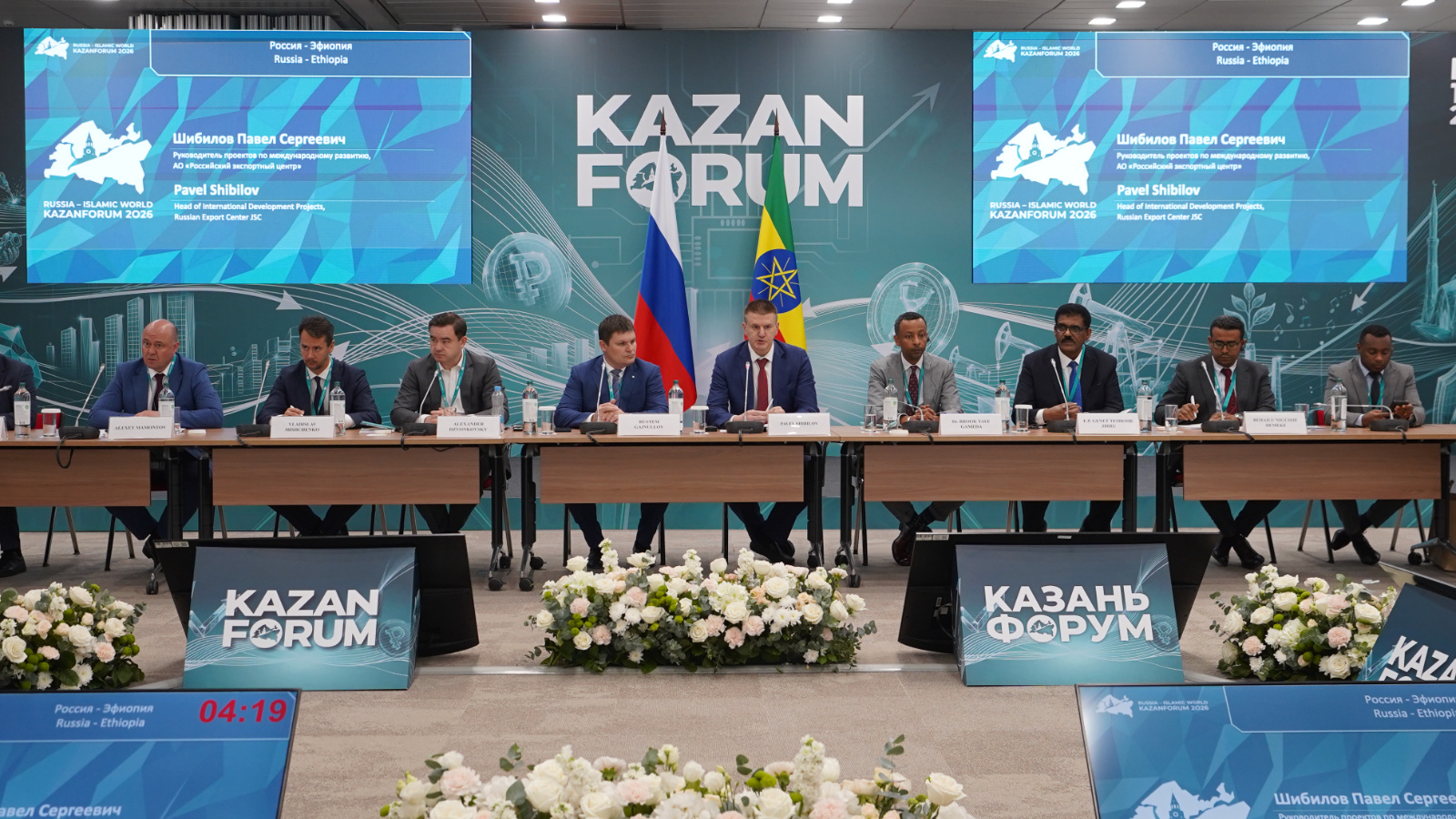
Today, a business session, "Russia – Ethiopia," was held on the sidelines of the 17th International Economic Forum "Russia – Islamic World: KazanForum." Rustem Gainullov, Deputy Minister of Agriculture and Food of the Republic of Tatarstan, participated in the session. Pavel Shibilov, Head of International Development at JSC Russian Export Center, moderated the session.
The session was also attended by Genet Teshome Jirru, Ambassador Extraordinary and Plenipotentiary of the Federal Democratic Republic of Ethiopia to the Russian Federation; Behailu Nigussie Demeke, CEO of the Ethiopian Trading Business Corporation; Brooke Taye Gameda, representative of the Ethiopian Investment Holding; Alexander Dzvonkovsky, Head of the Warehouse Business Development Directorate at Russian Post; and Alexey Mamontov, Director of the A.R. Shlyakhov Russian Federal Forensic Center under the Russian Ministry of Justice.
In his speech, Rustem Gainullov emphasized Tatarstan's high potential and mutual interest in developing cooperation in the agro-industrial complex.
Rustem Gainullov noted that for Tatarstan, one of Russia's leading agricultural regions, developing partnerships with African countries, and Ethiopia in particular, is a strategically important area. Ethiopia, with its growing economy and significant agricultural potential, represents a promising partner for the exchange of experience, technology, and food products.
The Deputy Minister presented key achievements of Tatarstan's agro-industrial complex: gross output exceeding 400 billion rubles in 2025, leading positions in milk, potato, and egg production, and the region's high level of self-sufficiency in food products. Particular attention was paid to the development of the food and processing industries, as well as the significant growth in agricultural exports, which have increased almost 1.8-fold over the past six years, reaching $539.4 million.
In his speech, Rustem Gainullov outlined several areas for cooperation with Ethiopia, including the export of Tatarstan food products, the exchange of experience in livestock and crop production, technological partnerships, collaboration in the processing and storage of agricultural products, and educational programs. He also expressed readiness to import coffee, oilseeds, and spices from Ethiopia for further processing and distribution on the Russian market in support of the national "Export" project.
In conclusion, the Deputy Minister proposed a number of practical steps to enhance cooperation: creating a list of partner companies, identifying pilot product areas, holding B2B meetings, and organizing business missions. Rustem Gainullov emphasized that Tatarstan is open to dialogue and aims to move from general discussions to the implementation of specific, mutually beneficial projects with Ethiopia.