Marsel Makhmutov: In 2025, 612 million rubles have been allocated from the republic's budget to support private farms in Tatarstan.
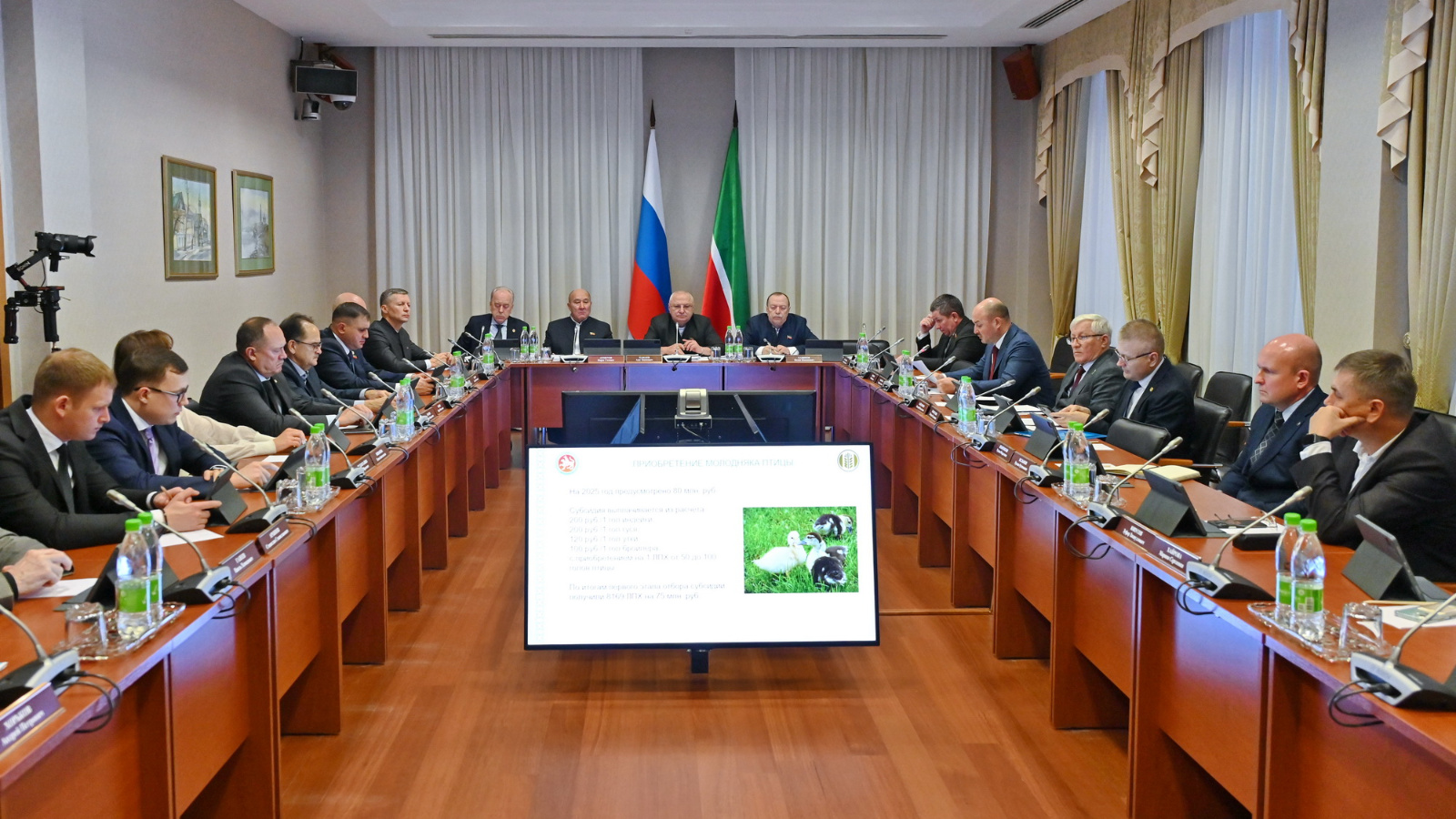
Support for the development of private farms was discussed at a meeting of the Committee on Ecology, Nature Management, Agro-Industrial and Food Policy and the committee's expert council. Deputy Chairman of the State Council Marat Akhmetov and Deputy Minister of Agriculture and Food of the Republic of Tatarstan Marsel Makhmutov participated in the meeting.
As Marsel Makhmutov noted, ten years ago, the State Council of the Republic adopted a law on state support for the development of private farms. Currently, there are more than 401,000 private farms operating in Tatarstan, conducting agricultural activities on their private plots. In 2024, farmers produced agricultural products worth 105.7 billion rubles. This represents a third (30.2%) of the total agricultural output produced by farms of all types in the republic. Private household plots produce 23% of milk, 22% of meat, 85% of potatoes, and 64% of vegetables. "The republic ranks fifth in the country in terms of the value of gross agricultural output from private household plots," the deputy minister emphasized. "The performance of private household plots is due to unprecedented budget support nationwide. In 2025, Tatarstan allocated 612 million rubles from the republic's budget to support them, of which 592 million rubles, or 97%, have already been spent."
The republic's support subsidizes a part of costs in five areas: cow and goat husbandry, construction of mini-dairy farms, raising mares over three years old, purchasing commercial and breeding stock of heifers and first-calf heifers, and purchasing young poultry. "70 million rubles have been allocated to support private household farms (PHFs) for the construction of mini-dairy farms in 2025. The subsidy is calculated at 500,000 rubles for mini-farms with five cows or more, and 1 million rubles for a dairy farm with eight cows or more. Following two rounds of selection in 2025, 79 PHFs received subsidies totaling 69.5 million rubles, or 99% of the allocated amount," said Marsel Makhmutov. "Thanks to this support, we plan to increase our herd size by 350 cows. Recipients have signed commitments to maintain their existing herd size for five years."
He also noted that additional applications for PHF subsidies are ongoing. Applications for mini-farm construction will be accepted until November 28, while selections for the purchase of commercial and breeding stock (heifers, first-calf heifers, and poultry) are scheduled from November 28 to December 7. "I would like to point out that all state support measures for private farms are compensatory in nature. To receive a subsidy, you must provide documents confirming the costs of feed, feed additives, and construction materials for mini-farms. Documents are submitted electronically through the 'My Subsidies' system, which guarantees a simple, transparent, and efficient process for providing state support," concluded Marsel Makhmutov.
During the discussion, Nazip Khazipov, Deputy Chairman of the Committee on Ecology, Nature Management, Agro-Industrial and Food Policy, inquired about the growth of mini-farms in municipal districts that keep three or more cows. "Regarding this growth, unfortunately, the number of cows in the republic decreased by 25,000 between 2019 and 2024. At the same time, program participants have shown positive growth; for example, 1,217 mini-farms have been built, resulting in an increase of 5,349 cows," noted Marsel Makhmutov.
Deputy Chairman of the State Council Marat Akhmetov recommended that the relevant ministry explore new avenues for supporting private farms, in addition to those already in place. For example, consider subsidizing the purchase of single-grain feed and developing high-tech projects for family farms. According to Akhmetov, the population in rural areas is aging every year, but it's urgent to consider ways to preserve mini-farms, simplifying and systematizing this approach to preserve livestock. "A few years ago, we proposed mechanized manure removal and milk pipelines," Akhmetov noted. "We need to help, for example, those who keep 5-8 cows. So, try to study this issue and develop high-tech projects for family farms and micro-firms. The Rais of the Republic raises this issue at weekly meetings, and we must consider how to preserve the dairy herd."
The Chairman of the Committee on Ecology, Nature Management, Agro-Industrial and Food Policy, Azat Khamaev, in turn, proposed that the Ministry of Agriculture of the Republic monitor positive practices in supporting private household plots in the regions, as well as analyze regulatory legal acts governing the provision of state support measures to citizens running private household plots, and, if the need for additional legal regulation is identified, ensure the adoption of relevant regulatory legal acts.