The 26th Congress of the Association of Farmers of the Republic of Tatarstan was held at the Ministry
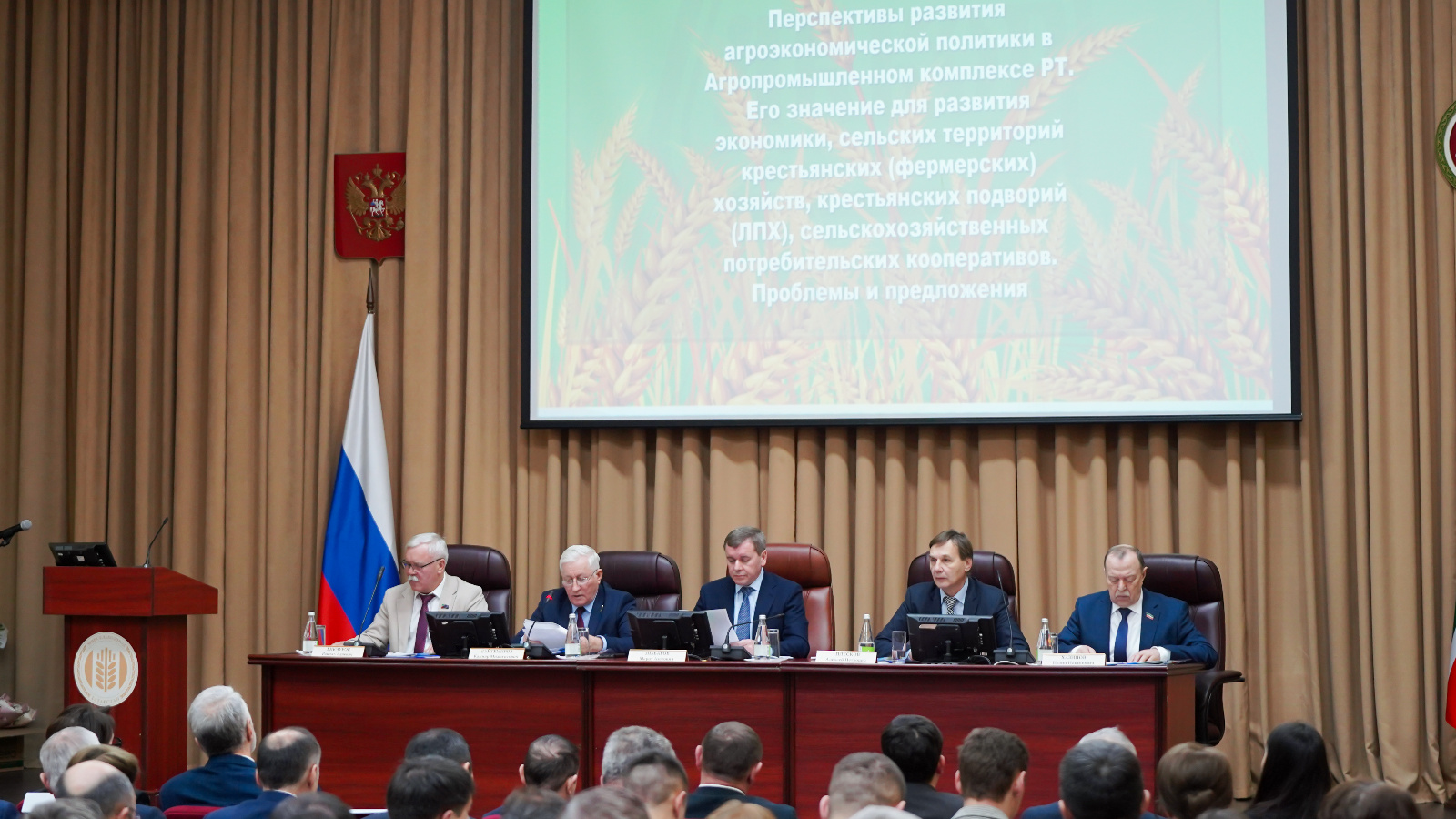
Today, the 26th Congress of the Association of Farmers, Farmsteads, and Agricultural Consumer Cooperatives of the Republic of Tatarstan was held at the Ministry of Agriculture and Food of the Republic of Tatarstan. The congress discussed the prospects for the development of agro-economic policy in the republic's agro-industrial complex, as well as its importance for the economic development of rural areas, peasant farms, private farms, and agricultural consumer cooperatives.
The presidium included Marat Zyabbarov, Deputy Prime Minister of the Republic of Tatarstan and Minister of Agriculture and Food; Alexey Pleskov, Director of the Skolkovo Foundation's Center for the Development of Technologies in Biology, Medicine, and Agriculture; Kamiyar Baitemirov, President of the Association of Farmers, Peasant Farmsteads, and Agricultural Consumer Cooperatives of the Republic of Tatarstan; Nazip Khazipov, Deputy Chairman of the State Council Committee on Ecology, Nature Management, Agro-Industrial, and Food Policy; and Ravil Bikchurov, Chairman of the Association of Farmers, Peasant Farmsteads, and Agricultural Consumer Cooperatives of the Drozhzhanovsky District of the Republic of Tatarstan.
Kamiiyar Baitemirov spoke about the volume of agricultural output produced by small farms, their numbers, and grant support. "Small farms received 160 billion rubles in gross agricultural output in 2025," he said. These include more than 400,000 private farms, more than 2,000 farms, and approximately 400 agricultural consumer cooperatives," he added.
Marat Zyabbarov spoke about direct support for small businesses in 2025, which amounted to 1.5 billion rubles across six areas with federal co-financing and nine republican co-financing.
"For 2026, direct support for farms is planned at 488 million rubles, which is 163 million more than last year. I ask you to identify business development projects and begin preparing applications," the minister noted.
According to him, since 2020, the number of active cooperatives has increased, reaching 215 units. Over 22,000 farms and private farms are involved in the cooperative movement. The volume of services and product processing has grown to 18.5 billion rubles, three times the 2020 figure.
Marat Zyabbarov cited the example of the "Yan" cooperative in the Sarmanovsky District. In 2023, it won a grant of 9.7 million rubles to build a poultry slaughterhouse. Using its own funds, the cooperative built and fully equipped a modern 650-square-meter facility. The facility was launched in November 2025 and, in just two months, processed over 35,000 birds at a cost of 80 rubles per bird. Farmers and private households in three districts—Sarmanovsky, Muslyumovsky, and Agryzsky—now actively use its services.
The minister also noted the activities of industrial parks, which provide residents with gas, water, sewerage, low-voltage networks, and roads, emphasizing that this allows cooperatives to avoid additional costs and time-consuming paperwork when starting a project.
Marat Zyabbarov said: "For profitable business, it is essential to participate in training and attracting personnel; this is the foundation of the farms' economy. Last year, the federal project "Personnel in the Agro-Industrial Complex" was launched as part of the national project "Technological Support for Food Security."
One of the federal project's steps is the renovation of agricultural technology classrooms in rural schools. This will enable the introduction of a new, modern model of specialized education with an in-depth curriculum in the natural sciences and exact disciplines. The key principle is close collaboration between schools, colleges, universities, and future employers. The government supports the initiative, reimbursing the investor for 90% of the costs.
Alexey Pleskov noted that over the 15 years of the Skolkovo Foundation's work, it has succeeded in building a system of relationships between the government, business, science, and innovators. "These innovators are the people who start or scale businesses based on new technological ideas. And our work is aimed at supporting and developing them," he said.
The congress also focused on the development of sheep farming, livestock farming, and dairy production, rural development, the production of high-quality organic produce, and support for land reclamation.
At the end of the event, state and departmental awards were presented to agricultural workers who contributed to the industry's development.