Efficient agricultural land use issues were discussed at a meeting of the relevant committee.
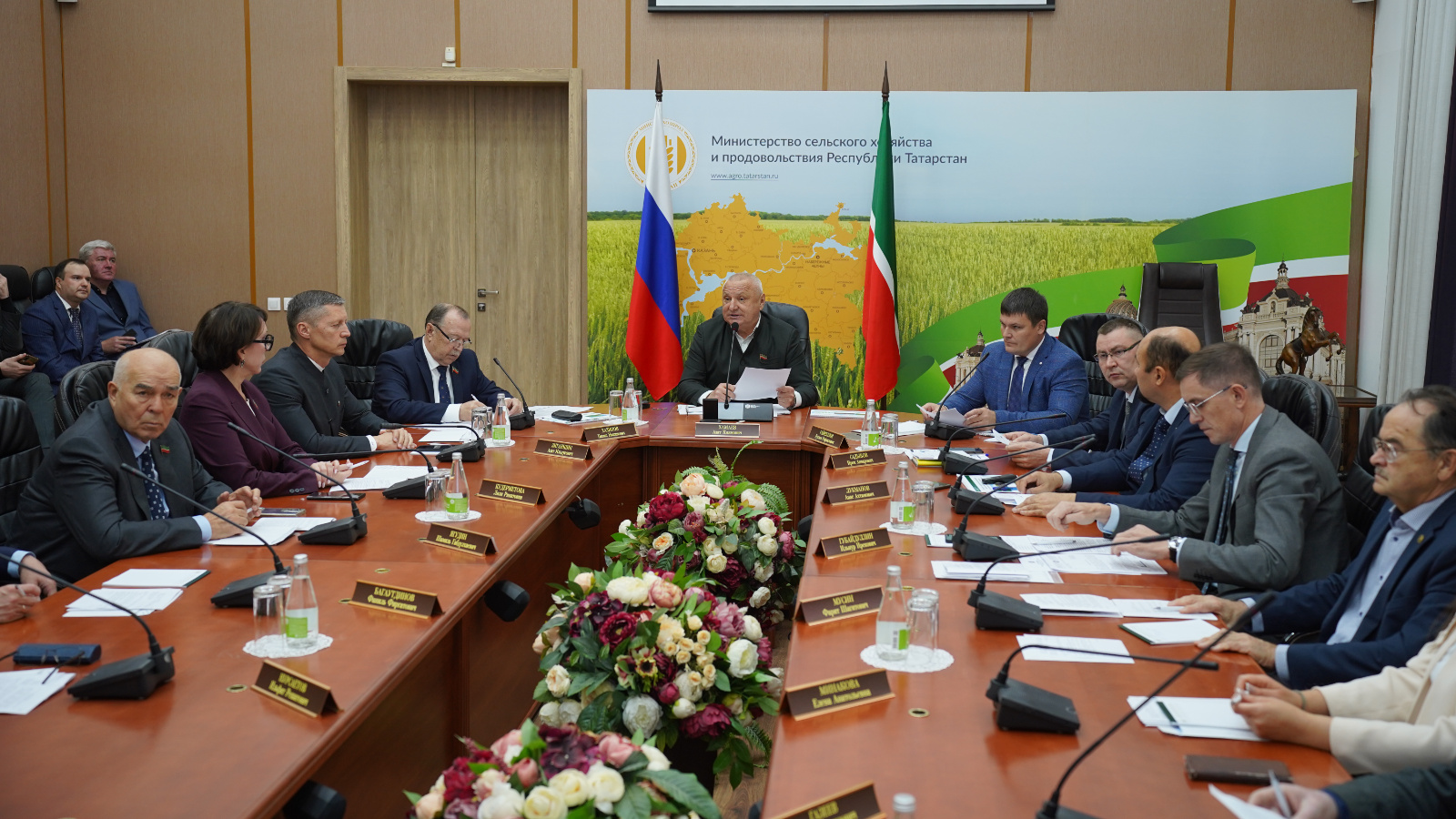
Today, the Tatarstan Ministry of Agriculture and Food held a joint off-site meeting of the Committee on Ecology, Nature Management, Agro-Industrial and Food Policy and the Committee's Expert Council. Members of parliament discussed law enforcement practices related to agricultural land use in Tatarstan. Furthermore, the committee meeting considered a draft law amending the republic's Environmental Code and the republican law on the regulation of certain issues in subsoil use. Azat Khamayev, Chairman of the Committee on Ecology, Nature Management, Agro-Industrial and Food Policy, chaired the meeting.
Anas Lukmanov, Director of the Federal State Budgetary Institution "TsAS Tatarsky," presented a report on the state of soil fertility in Tatarstan. "The republic's total area is 6,783,000 hectares, of which nearly 4.5 million hectares are agricultural land," noted Anas Lukmanov. "The republic has over a million hectares of acidic soils, accounting for 44% of the surveyed arable land area. The presence of acidic soils is one of the main limiting factors for achieving high and stable agricultural yields."
Anaas Lukmanov also addressed the problem of declining soil fertility. "125 agricultural enterprises in Tatarstan meet the 'significant decline in soil fertility' criterion," he emphasized. "We identify approximately 20,000 hectares of such land annually. Meanwhile, our colleagues from Krasnodar, Stavropol, and Rostov-on-Don note that they don't have a single hectare of such land."
Nazip Khazipov, Deputy Chairman of the Committee on Ecology, Nature Management, Agro-Industrial and Food Policy, inquired why northern regions of Tatarstan, particularly Kukmorsky and Sabinsky, are more susceptible to soil fertility decline. "These regions have a unique, rolling topography, which results in increased soil erosion and the leaching of fine soil," noted Anas Lukmanov.
Irek Sadykov, Head of the Department for the Development of Agricultural Sectors at the Ministry of Agriculture and Food of the Republic of Tatarstan, also noted the urgency of the problem of declining soil fertility and nutrient loss. "Since 2019, Tatarstan has had a program subsidizing a portion of the cost of purchasing mineral fertilizers for agricultural producers," Sadykov noted. "In recent years, there has been a trend toward increasing the use of liquid fertilizers due to their higher digestibility. This allows for a significant reduction in costs and an optimal balance of mineral nutrition."
Rustam Gainullov, Deputy Minister of Agriculture and Food of the Republic of Tatarstan, spoke about the implementation of the "Avyl Yashi – The Village Lives" project in Tatarstan at a committee meeting.
The project has been implemented since 2023 in four districts of the republic: Agryz, Apastovsky, Bavlinsky, and Baltasinsky. "Its goal is to inform rural entrepreneurs about forms of agribusiness support and the use of best practices," noted Rustam Gainullov. "This project primarily aims to preserve and revive villages, increase the competitiveness of small and medium-sized businesses, and create an information and methodological base for various areas of agriculture. A training program has been developed, covering 35 areas. The training topics cover issues of government regulation and support measures, farm economics and management, and practical aspects of running agribusiness."
From 2023 to 2025, the Ministry of Agriculture and Food, with the participation of specialists from the Ministry of Economy and the Ministry of Labor, Employment, and Social Protection, conducted 10 thematic training sessions for residents of the republic's districts via videoconferencing. "The Ministry of Agriculture and Food will continue to implement this project and roll it out to all districts," the Deputy Minister emphasized.
At a committee meeting today, parliamentarians reviewed a draft amendment to Article 45 of the Republic's Environmental Code and Article 10 of the republican law on the regulation of certain issues in subsoil use. The draft law proposes to strengthen the authority of the regulatory body to issue orders to eliminate identified violations of mandatory requirements based on the results of regulatory activities without prior interaction with the regulated entity. Currently, the regulatory body issues warnings in the form of admonitions regarding the inadmissibility of violating mandatory requirements. Such warnings are preventative in nature and merely recommend measures to comply with the requirements. They do not impose obligations to provide information, and failure to comply does not entail direct punishment.
"We believe that enshrining the right to issue orders at the legislative level will improve the effectiveness of responses to environmental violations," noted Ilnur Gubaydullin, First Deputy Minister of Ecology and Natural Resources of the Republic of Tatarstan.
The bill will be considered in its first reading at the next meeting of the State Council.