The Ministry discussed key issues of the agro-industrial complex
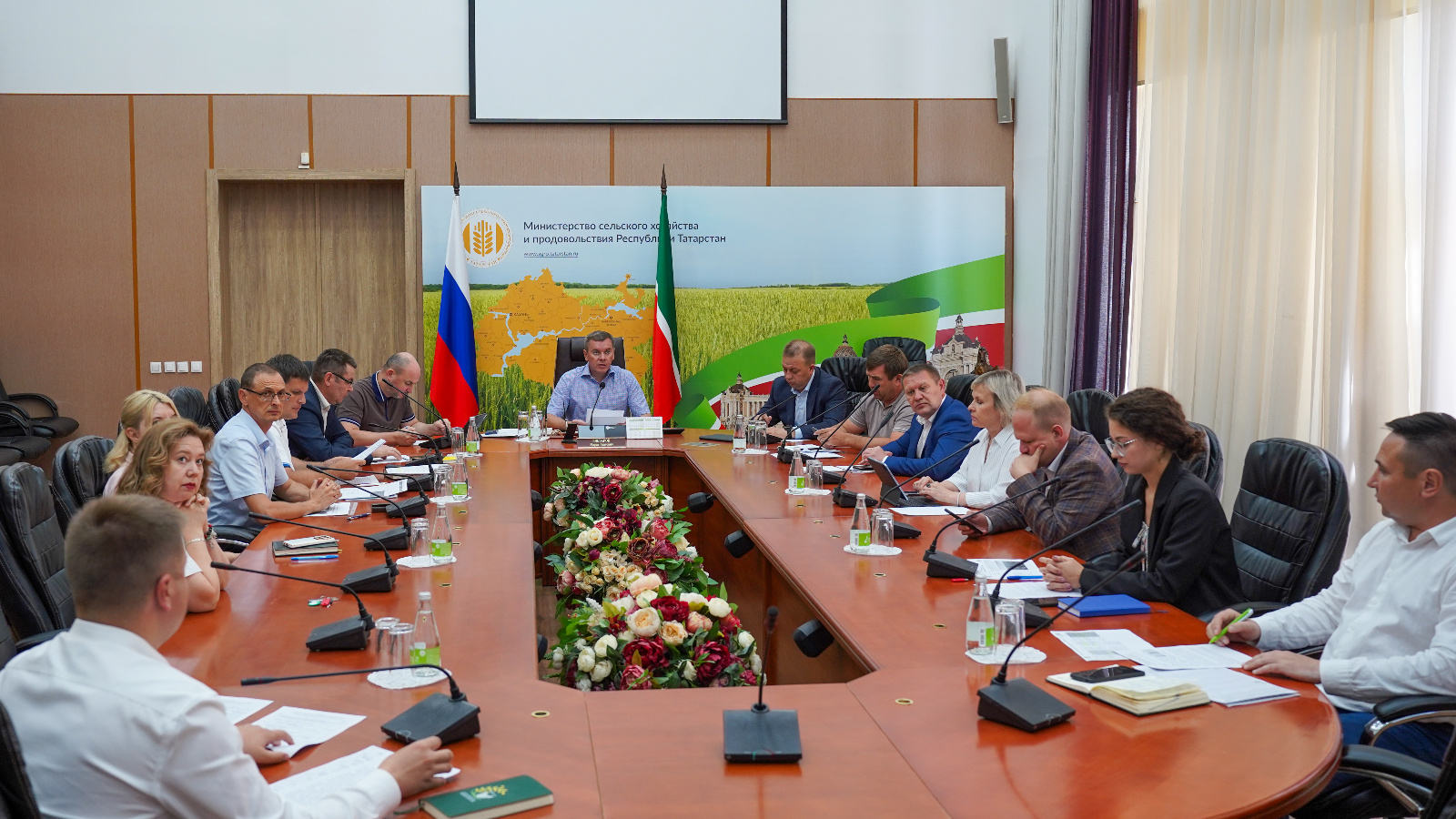
Today, the Ministry held a videoconference meeting on issues of the agro-industrial complex of the Republic of Tatarstan chaired by Deputy Prime Minister of the Republic of Tatarstan - Minister of Agriculture and Food Marat Zyabbarov. Deputy ministers, heads of municipal districts, heads of departments of the ministry and major investors took part in it.
Leading adviser of the land and property relations department Gulfina Valiullina reported on the issues of transferring agricultural lands.
"In accordance with Federal Law No. 52-FZ of April 1, 2025 "On Amendments to Certain Legislative Acts of the Russian Federation", from March 1, 2026, the transfer and change of the functional zone of agricultural lands will be possible only with the approval of the highest official of the subject and the conclusion of the Ministry of Agriculture of Russia," the leading adviser noted.
"From January 1, 2027, it is planned to reduce the number of grounds for transferring agricultural land to other categories. Also, the Federal Law will establish a complete ban on the transfer of land included in the list of especially valuable agricultural lands," she emphasized.
Deputy Minister Rafael Fattakhov spoke about the results of the acceptance competition for grain harvesting equipment, labor protection in agricultural enterprises and the mechanism for updating the equipment fleet.
According to Fattakhov, special attention is paid to attracting young assistants and machine operators to work with combines. Effective measures to support and stimulate young specialists in the agricultural sector are discussed.
"The high cost of spare parts for agricultural machinery and the rise in prices for them remain an acute problem. To update the technical fleet, it is necessary to widely use the programs of "Rosagroleasing". Support is provided by the Government of the Republic of Tatarstan, and seminars are planned aimed at improving the efficiency of agricultural enterprises," the Deputy Minister noted.
"This year, a total of 23 new combines have been purchased. Also, to increase the productivity of harvesting work, the practice of using carriers is being introduced. Examples of successful organization of such work are being discussed. Control over compliance with safety regulations during the harvesting campaign has been strengthened. The main attention will be paid to labor protection issues, providing workers with special clothing and equipment with fire extinguishing equipment," noted Rafael Fattakhov.
Then Deputy Minister Gelyus Bayazitov summed up the results of milk production and procurement of feed for the current period.
"Today, the Republic of Tatarstan milks more than 5,200 tons of milk per day, with an increase of 6% compared to last year. Atninsky, Kaibitsky, Mamadyshsky, Menzelinsky, Kukmorsky and Zelenodolsky districts show good rates of milk yield. This is due to large dairy complexes and the introduction of modern technologies," noted Gelyus Bayazitov.
According to the Deputy Minister, 299 thousand hectares of perennial grasses have been mown as of July 16, which is 97% of the total area. 255 thousand tons of hay have been harvested (78% of the plan), 2 million 051 thousand tons of haylage (62%), which is 15.6 centners of feed per 1 conventional head. Last year, this figure was 13.7 centners of feed (feed requirements: hay - 327 thousand tons, haylage - 3 million 274 thousand tons, silage - 3 million 742 thousand tons).
“Haylage harvesting at late harvesting dates leads to low nutritional value of feed and, as a consequence, to loss of productivity of cows when fed without the use of additional feed additives,” he emphasized.
Deputy Minister Rustem Gainullov reported on the harvesting of forage for personal subsidiary farms.
"As of today, 336 thousand tons of hay or 71% of the need have been prepared in private household plots, taking into account the carryover balance of 2024, the population's provision with feed is 85%. We have fully provided private household plots with feed in 14 municipal districts," the deputy minister said.
He also touched upon the issues of selection for state support programs and asked to actively participate in them, paying attention to the quality of the submitted documents, since the final selection result and the possibility of implementing projects in the territories depend on this.
During the meeting, the participants also discussed the implementation of the regional project "Rural Youth" in 2025, plans for organizing this project.