Agricultural development issues were discussed at a meeting of the Committee on Ecology, Nature Management, Agro-Industrial and Food Policy.
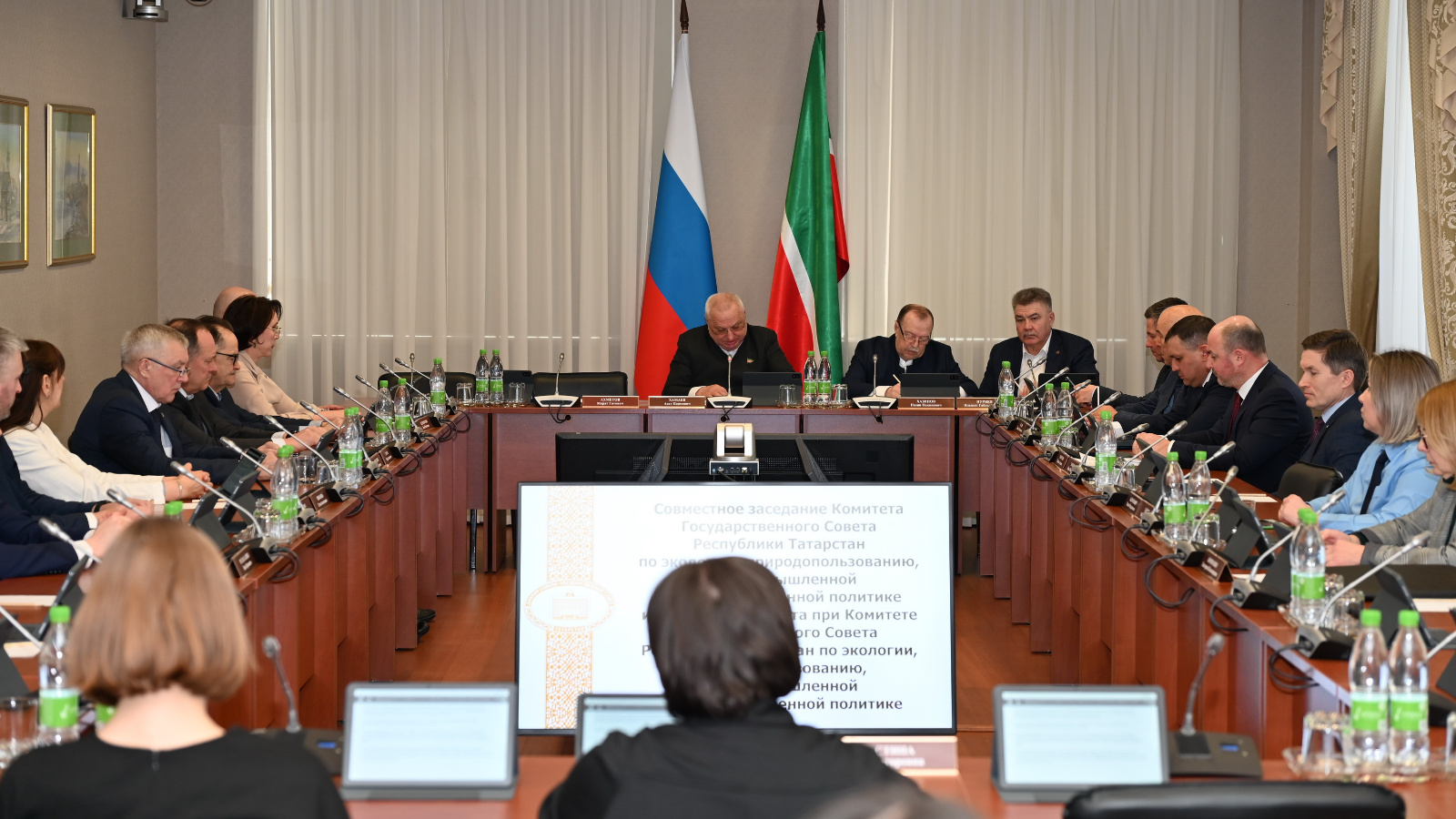
Today, a joint meeting of the Committee on Ecology, Nature Management, Agro-Industrial and Food Policy and the Committee's Expert Council was held in the State Council. At the meeting, parliamentarians discussed the implementation of the state program for agricultural development and regulation of agricultural produce, raw materials, and food markets, as well as a draft law amending certain articles of the Republic's Environmental Code.
Deputy Minister of Agriculture and Food Marsel Makhmutov presented information on the results of the state program "Agricultural Development and Regulation of Agricultural Produce, Raw Materials, and Food Markets in the Republic of Tatarstan" for 2025 and plans for the first half of 2026. Summing up the past year, he noted that the republic's agricultural sector had demonstrated good results: the volume of produced goods exceeded 400 billion rubles for the first time (+107.3% compared to the previous year). The total output of the agro-industrial complex, including the food industry, amounted to 772 billion rubles. Over the past five years, investments in modernizing the agricultural sector and food industry have amounted to 193 billion rubles.
Analyzing the objectives for the coming year, the Deputy Minister of Agriculture and Food of the Republic of Tatarstan noted that the state program to support agriculture has allocated subsidies totaling 16.6 billion rubles, 4.3 billion of which come from the federal budget.
Marsel Makhmutov also discussed the reduction in the purchase price of milk. This year, the price fell by 9 rubles to 36 rubles excluding value-added tax. According to the Deputy Minister, this jeopardizes the implementation of several investment projects. Despite an increase in milk sales by 10,000 tons in January, the additional farm income was offset by lower prices, resulting in a loss of 1.5 billion rubles.
In 2025, 1.5 billion rubles have been allocated for direct support of small farms across six programs with federal co-financing and nine republican programs. According to Marsel Makhmutov, the most effective form of support is the construction of mini-farms. Despite the overall decline in livestock numbers in the republic, program participants increased their cattle herd by 5,349 head over six years. In 2025, 80 new mini-farms were built with state support of 69.9 million rubles. This year, the herd is expected to increase by another 360 cows.
As Marsel Makhmutov noted, the republic is actively participating in the state program "Comprehensive Development of Rural Areas," aimed at improving living conditions in rural areas. In 2025, funding for activities under this program amounted to 4.1 billion rubles. This year, its budget will increase to 10.6 billion rubles.
Speaking about the upcoming sowing campaign, Marsel Makhmutov noted that costs will amount to approximately 43 billion rubles. Before the start of fieldwork, agricultural producers will receive over five billion rubles in state support. "The year has been successful so far: winter crops are in good and satisfactory condition at 98%; from autumn to now, 277 millimeters of precipitation have fallen, which is 130% above the norm. The average snow depth in the region is 64 centimeters, double last year's figures," he noted.
During the discussion, State Council Deputy Nikolai Atlasov asked about the impact of the VAT increase on the cost of agricultural products. The Deputy Minister confirmed a slight price increase.
Deputy Nazip Khazipov expressed surprise that not a single new private farm was built in 18 districts of the republic over the course of a year, while in others, between four and eleven farms were built. "It's very sad to see this situation, because private farms create new jobs, support rural life, and help address demographic issues," Nazip Khazipov emphasized. Addressing a representative of the Ministry of Agriculture and Food of the Republic of Tatarstan, Azat Khamayev proposed regularly monitoring the number of farms built by district, year, and size.
A bill amending Articles 83 and 98 of the Environmental Code of the Republic of Tatarstan was also considered at a committee meeting today. On January 9, 2026, amendments were made to the Water Code of the Russian Federation, allowing the temporary use of vehicles within water protection zones, even without hard surfaces, but only for the construction of recreational facilities. For this purpose, temporary forest roads are permitted, which will then be dismantled and the area restored. Similar amendments are being introduced to the Environmental Code of the Republic of Tatarstan, in line with the changes of federal legislation.