The Ministry held a meeting on issues related to the agro-industrial complex of Tatarstan.
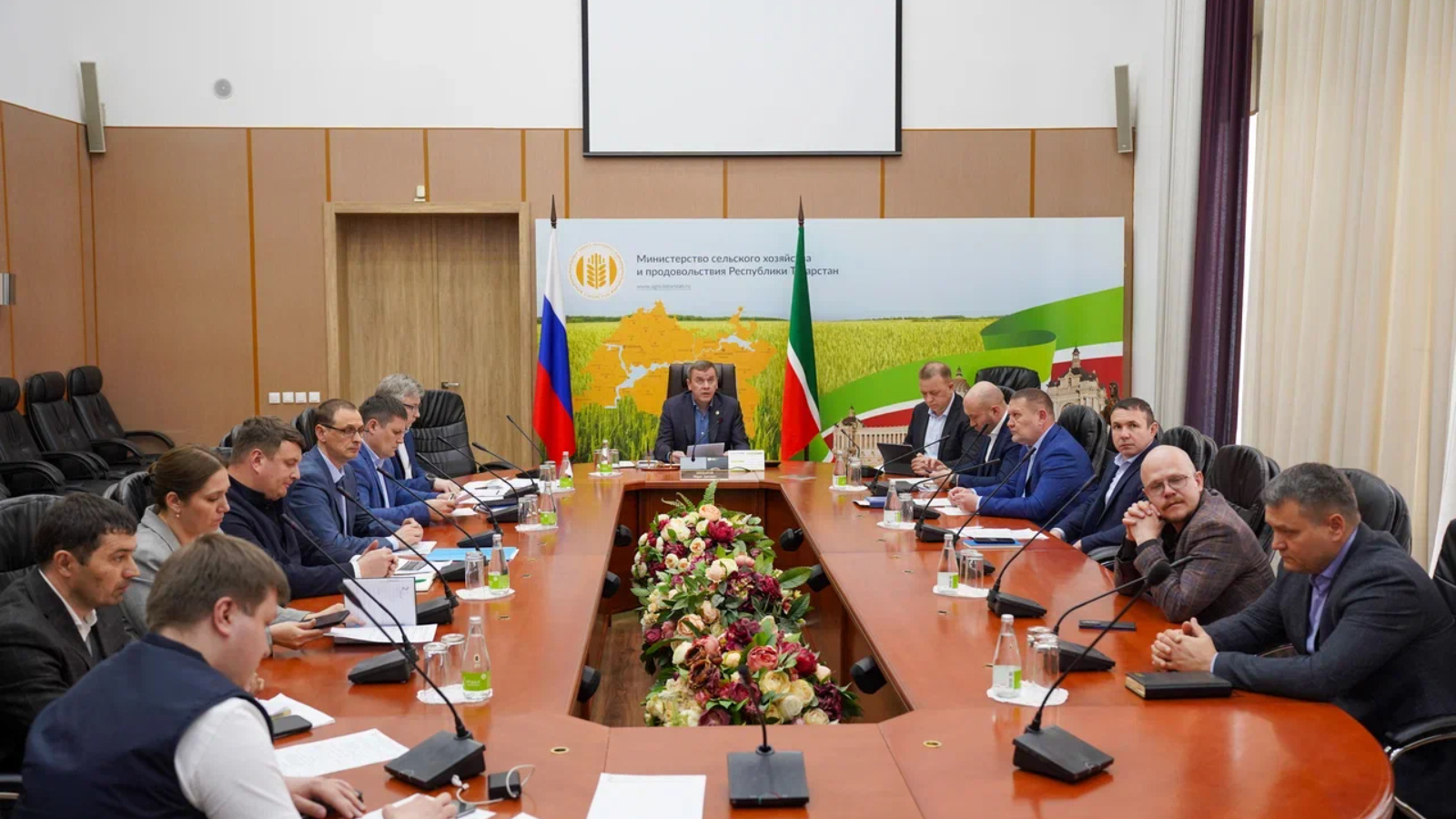
Today, the Ministry held a videoconference meeting on the agro-industrial complex of the Republic of Tatarstan, chaired by Marat Zyabbarov, Deputy Prime Minister of the Republic of Tatarstan and Minister of Agriculture and Food. Deputy ministers, heads of municipal districts, heads of agricultural departments, department heads, and major investors participated.
Dmitry Yashin, Deputy Minister of Agriculture and Food of the Republic of Tatarstan, reported that moisture accumulation in the republic from October to the present averages 138% of the long-term average. These values are a good indicator for the continued development of plants.
"The republic began spring fieldwork on April 16." Winter crop fertilization has been completed on 292,000 hectares, which is 60% of the planned total for perennial grasses, covering an area of 93,000 hectares or 30% of the planned total. Winter crop harrowing has been completed today on 44,000 hectares, and perennial grasses on 77,000 hectares. Harrowing of fallow land and fallow land has also begun. The accumulation of mineral fertilizers for the 2026 harvest in Tatarstan is 74.4 kg active ingredient/ha," noted Dmitry Yashin.
Vitaly Novichkov, head of the Tatarstan branch of the Federal State Budgetary Institution "Rosselkhoztsentr," reported on the status of winter crops in the Republic of Tatarstan. "Monitoring conducted by our staff shows that after the winter, winter crop losses amounted to approximately 400 hectares, while approximately 98% of our crops are in good, satisfactory condition," he emphasized.
Deputy Minister Marat Karimov spoke about preparing equipment for the 2026 fieldwork, updating equipment, and using unmanned aerial systems.
"During the current sowing campaign, farms plan to use 11,000 tractors, 2,500 trucks, 880 seeding complexes, 4,600 drills, and 5,300 tillage machines. From March 23 to 27, districts conducted acceptance tests of seeding equipment. Farms in the Yutazinsky and Mendeleyevsky districts were re-accepted, and their deficiencies were addressed promptly. Despite the start of spring fieldwork, I ask farm managers to prepare forage harvesting and harvesting equipment in a timely manner," the Deputy Minister noted.
"Recently, increasing importance has been placed on the use of unmanned systems in the production process. The use of drones for crop processing is proving its effectiveness. In 2025, 40,500 hectares of agricultural crops were processed using UAVs. In 2026, approximately 100,000 hectares are planned to be processed using UAVs. "The area is growing," said Marat Karimov.
Deputy Minister Gelyus Bayazitov summarized the livestock sector's performance for the first quarter of 2026. "The republic's agricultural enterprises produced 484,000 tons of milk, a 6% increase compared to 2025. The average milk yield per cow was 2,260 kg, a 7% increase compared to last year. 104,000 tons of meat were produced, 102% compared to last year. Pork production has shown positive trends, 110% compared to 2025. Milk production has shown positive trends, increasing by 29,000 tons compared to last year, or 106% compared to 2025. "The largest increases were in the Kaibitsky, Atninsky, and Menzelinsky districts. High growth rates were also observed in the Agryzsky, Chistopolsky, and Leninogorsky districts," noted Gelyus Bayazitov.
Deputy Minister Niyaz Khuramshin then presented a report on support for private farms in 2026.
"In 2026, 465.0 million rubles have been allocated for the maintenance of cows, goats, breeding goats, and ewes, 68.4 million rubles for the construction of mini-farms, and 30.0 million rubles for the maintenance of mares over three years old. Selections for these areas are open from April 20 to May 4. I ask the heads of departments to disseminate this information and work on submitting high-quality applications for the subsidy," said Niyaz Khuramshin.
In summing up, the minister focused on organizing labor safety in production facilities and ensuring biological security at livestock farms in the Republic of Tatarstan. He also called for active and coordinated work by agricultural administrations, in collaboration with the Ministry of Agriculture of the Republic of Tatarstan, Rosselkhoznadzor, and the veterinary service of the Republic of Tatarstan.