Tatarstan's Agricultural Export Development Discussed at Kazan Agro 2026
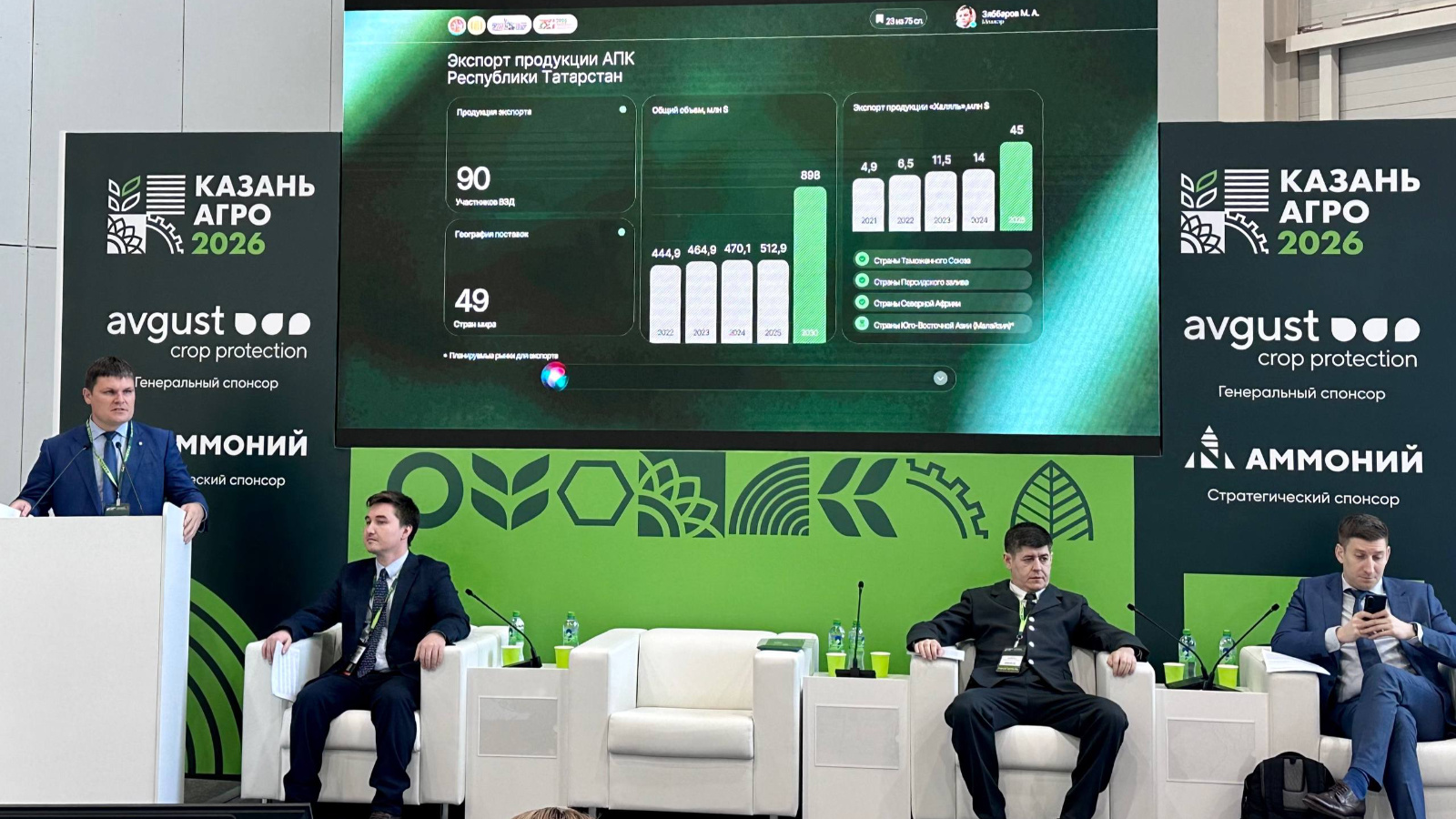
Today, a roundtable discussion titled "Export of Agricultural Products of the Republic of Tatarstan — a Vector of Development for the Agricultural Complex of the Republic of Tatarstan" was held as part of the specialized agricultural exhibition "Kazan Agro 2026." The meeting was moderated by Salavat Sakhabutdinov, Acting Head of the Department of International Cooperation and Agricultural Export Development of the Republic of Tatarstan at the Ministry of Agriculture and Food of the Republic of Tatarstan.
"The republic's agricultural complex is a modern, high-tech industry with good development potential. By the end of the year, export volumes reached $512.9 million, exceeding the same period last year by $43 million," noted Rustem Gainullov, Deputy Minister of Agriculture and Food of the Republic of Tatarstan.
Ninety foreign trade participants in the Republic of Tatarstan export agricultural products to 49 countries. The main export products are sunflower, cottonseed, safflower, rapeseed, and mustard oils, mayonnaise, sauces, oilcakes, and chocolate. Mutually beneficial relations strengthen partnerships and align with the goals of the national project "International Cooperation and Export."
In 2025, the volume of halal product exports from the Republic of Tatarstan amounted to $45 million. Today, there are over 150 producers in the Republic working according to halal standards, and approximately 20 of them are already actively supplying products to export markets, some of which have international halal certification.
"Agricultural exports from the Republic of Tatarstan already generate over half a billion dollars, but their growth potential remains enormous. "I am confident that through joint efforts, we will not only achieve but significantly exceed our goals, strengthen Tatarstan's position on the international stage, and ensure continued sustainable growth in the agricultural sector," added Rustem Gainullov.
Andrey Sukharev, Deputy Head of the Federal State Budgetary Institution "Agroexport," discussed promising areas for the development of agricultural exports and existing government support measures for exporters.
Andrey Sukharev emphasized that in recent years, Russia has been steadily increasing its influence in the global food market. By the end of 2024, exports exceeded $43 billion. "Russia has managed to maintain its sixteenth place globally in terms of the monetary equivalent of exported products among leading exporting countries. At the same time, we occupy a leading position in the supply of grains, legumes, vegetable oils, and frozen fish," he said.
According to Andrey Sukharev, last year wasn't the easiest for companies in terms of agricultural exports, and this was due to international market conditions. "This primarily included the strengthening of the ruble and trade wars waged by key global exporters, as well as high competition in global markets driven by good harvests of grains, legumes, and oilseeds. And yet, we still achieved decent results," he added.
A program for export development through 2030 has been developed jointly with the Federal State Budgetary Institution Agroexport. It identifies priority markets, financial support mechanisms, product standardization, and the promotion of domestic products on international markets.
Airat Tazetdinov, Deputy Head of the Federal Service for Veterinary and Phytosanitary Surveillance (Rosselkhoznadzor) for the Republic of Tatarstan, discussed the agency's responsibilities in agriculture, including federal state veterinary and quarantine phytosanitary control, seed production control over agricultural seeds, control over the import of genetically modified organisms and seeds into Russia, and federal state control over the safe handling of pesticides and agrochemicals.
Abbyas Shlyaposhnikov, Chairman of the Halal Standards Committee of the Spiritual Administration of Muslims of the Republic of Tatarstan, noted: "We are working productively to develop cooperation with global Islamic organizations. Last year, the committee received accreditation to certify manufacturers for product exports to Persian Gulf countries."
According to him, the committee is a certification body that facilitates the integration of Tatarstan and Russia into the global halal industry and supports the strengthening of economic ties with countries of the Islamic world.
Yulia Selezneva, Head of Export Sales at Vamin Group, reported that the group's turnover for 2025 was 29 billion rubles. The company is one of Russia's top three cheese producers and the leader in dairy exports and milk processing in the Republic of Tatarstan.
During the roundtable, participants also discussed accreditation for target export markets, international Halal certification for GCC and Southeast Asian countries, market needs, import conditions.