Tatarstan summarized the year-end results of the federal project "Human Resources in the Agro-Industrial Complex"
Since the beginning of 2025, the Republic of Tatarstan has been implementing the national project "Technological Support for Food Security." Five federal projects are being implemented within its framework: "Creating Conditions for the Development of Scientific Research in Breeding and Genetics," "Veterinary Drugs," "Technical and Technological Independence of Agriculture, Food, and Processing Industries," "Human Resources in the Agro-Industrial Complex," and "Production of Critically Important Enzyme Preparations, Food and Feed Additives, and Technological Aids."
The federal project "Human Resources in the Agro-Industrial Complex" aims to create a seamless trajectory for training personnel from school to agro-industrial enterprises, which will facilitate the development of a system integrating educational institutions and businesses.
The total funding volume last year amounted to 1 billion 269 million rubles. As part of the project, 46 residential units were purchased to provide accommodation for research staff at the Kazan State Agrarian University. Work is actively underway to reconstruct and equip the university building. Reimbursement of wage and accommodation costs for 317 students recruited for internships has been organized, as well as reimbursement of expenses under signed apprenticeship contracts and targeted training agreements for 126 students.
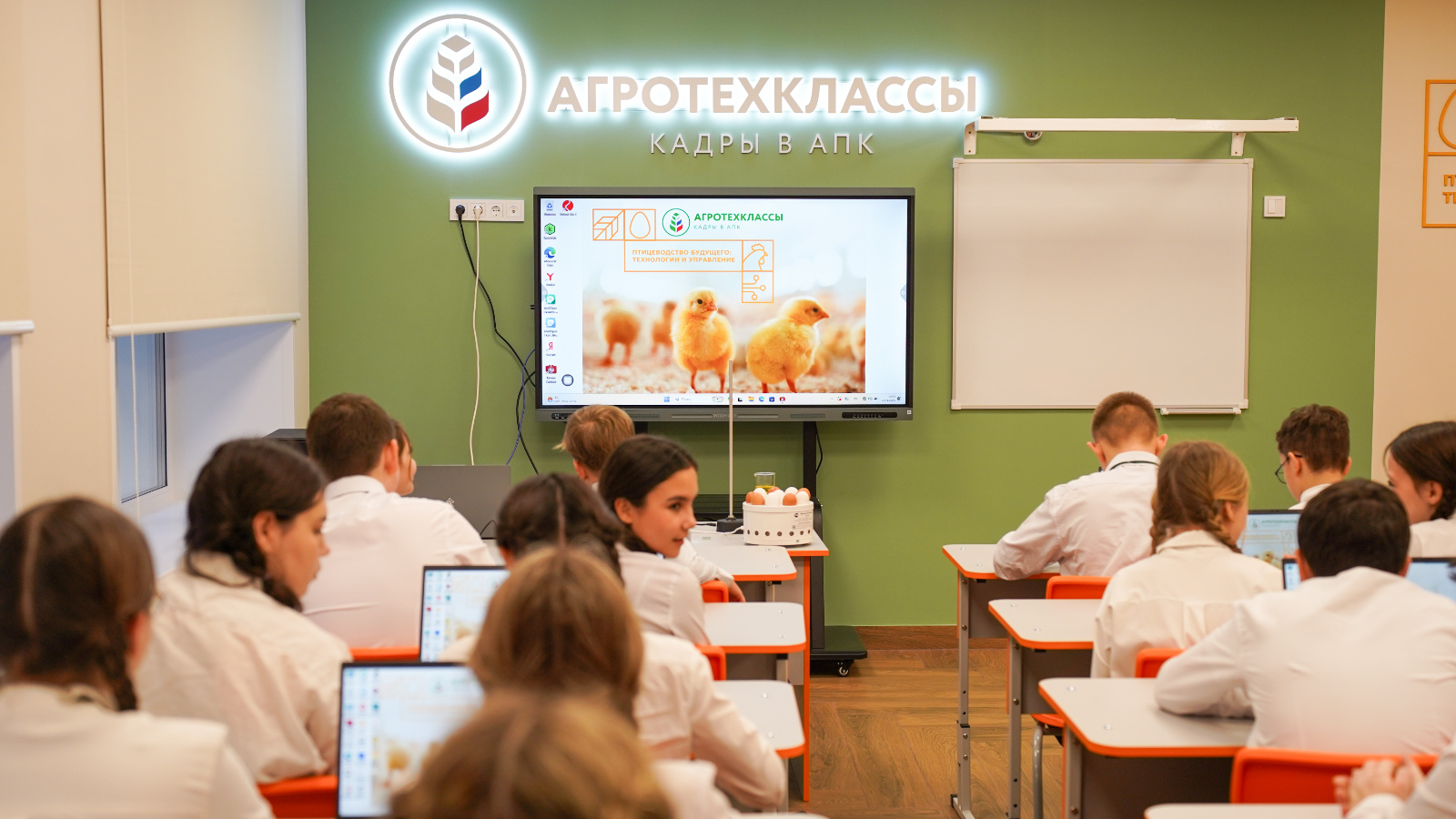
Agrotechnology classes have also been opened in 20 schools in the areas of genetics and breeding, efficient livestock farming, modern biotechnology, poultry farming, agricultural engineering, and floriculture in 14 districts of the republic: Kukmorsky, Vysokogorsky, Mamadyshsky, Zelenodolsky, Sabinsky, Baltasinsky, Arsky, Chistopolsky, Novosheshminsky, Laishevsky, Tukaevsky, Almetevsky, Bugulminsky, and Menzelinsky municipal districts.
This year, 35 schools are expected to open agro-technology classes. Physics, chemistry, mathematics, and biology teachers in these classes will receive incentive payments of 30,000 rubles per month. Last year, 80 teachers received these payments, and this year, over 130 are expected.
According to Marat Zyabbarov, Deputy Prime Minister of the Republic of Tatarstan and Minister of Agriculture and Food of the Republic of Tatarstan, the creation of agro-technology classes, support for young specialists, and the retraining program constitute a unified strategy. "Its goal is to provide the agro-industrial complex of the Republic of Tatarstan with competent, motivated, and in-demand specialists at all levels, from the workplace to management," the minister noted.