The Ministry held a meeting to review the development of the livestock sector over the past nine months.
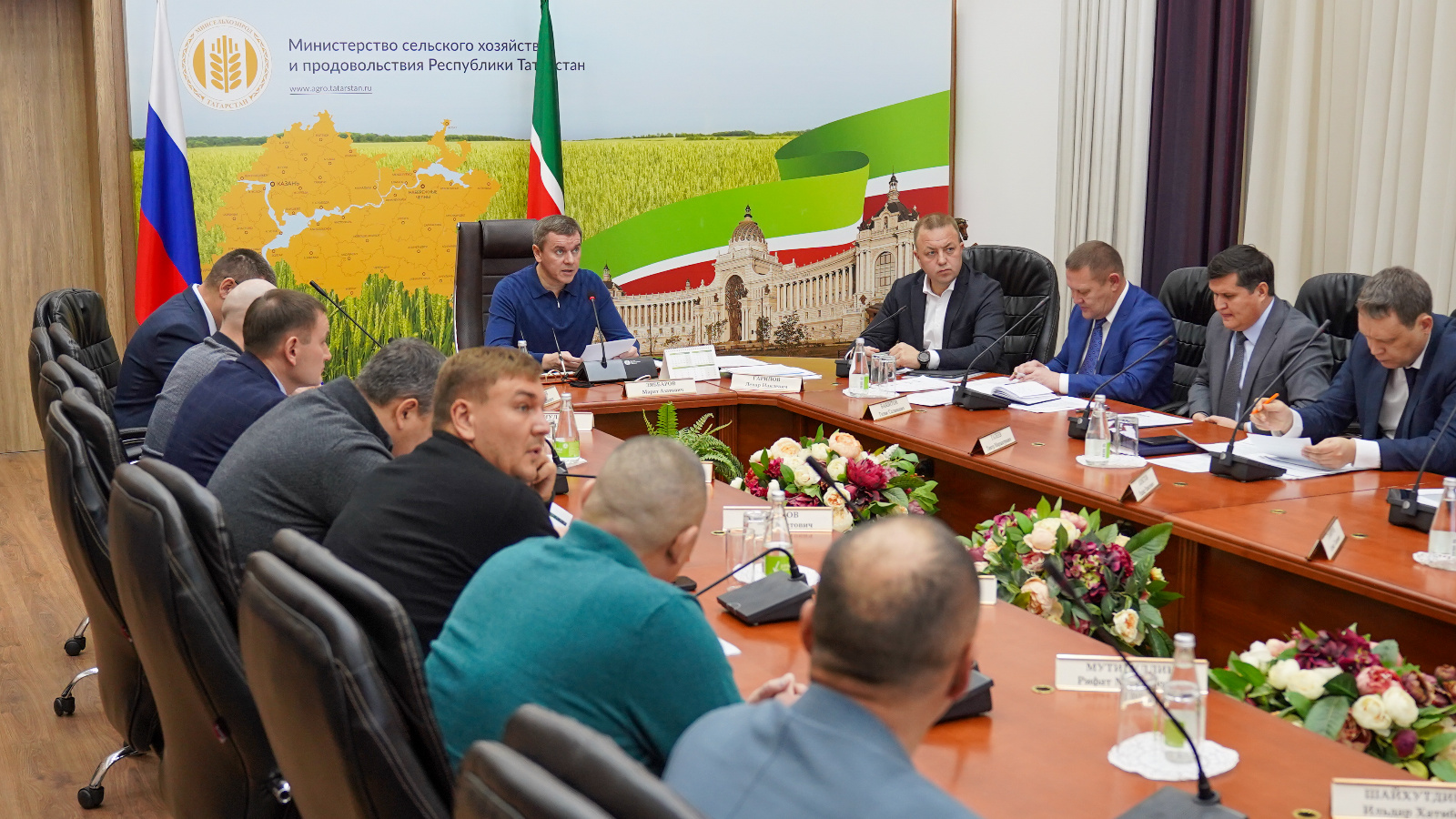
Today, the Ministry held a meeting to review the development of the livestock sector over the past nine months. The meeting was chaired by Marat Zyabbarov, Deputy Prime Minister of the Republic of Tatarstan and Minister of Agriculture and Food of the Republic of Tatarstan. The event was attended by Gelyus Bayazitov, Deputy Minister of Agriculture and Food of the Republic of Tatarstan; Timur Galeev, Head of the Main Veterinary Department of the Cabinet of Ministers of the Republic of Tatarstan; Rashid Akhmetov, Director of the State Budgetary Institution "Competence Center for the Development of Agricultural Cooperation in the Republic of Tatarstan"; heads of industry departments of the Ministry of Agriculture and Food of the Republic of Tatarstan; heads of municipal districts; heads of investment companies; and heads of agricultural departments in municipal districts of the Republic of Tatarstan.
Deputy Minister Gelyus Bayazitov summarized the livestock sector's performance in the first nine months of 2025 in Tatarstan's agricultural enterprises.
This year, 154 billion rubles were received from agricultural sales, 70% of which, or 107.4 billion rubles, came from livestock farming, with a 20% increase compared to the previous year.
"It includes 56.5 billion rubles from milk sales (133% of 2024 levels), and 43.3 billion from livestock and poultry (114%). Meanwhile, cash revenue from egg sales, despite a 4% increase in volume, was only 83% of 2024 levels. This is due to a decrease in purchase prices by 1 ruble 87 kopecks," the Deputy Minister noted.
As Gelyus Bayazitov noted, 1,405,000 tons of milk were produced in the first nine months of this year, representing 106% of the 2024 target. The Atninsky, Mamadyshsky, Menzelinsky, and Kukmorsky districts are leading the way, accounting for 78% of the increase. These districts boast a high level of implementation of advanced technologies in modern dairy complexes. At the same time, he emphasized that 15 districts have negative milk yield indicators.
According to the Deputy Minister, agricultural enterprises are achieving good results thanks to the construction of modern dairy complexes. Seven dairy complexes with a capacity of 2,576 head have been commissioned this year. Twenty-eight investment projects involving 20,000 cows are currently at various stages of implementation.
"High growth rates in beef production are primarily found in districts with high rates of dairy herd survival and high rates of milk production growth," he emphasized.
Timur Galeev, Head of the Main Veterinary Department of the Cabinet of Ministers of the Republic of Tatarstan, spoke about the epizootic situation in the Republic of Tatarstan and preventive measures.
The Russian Federation currently faces a challenging epizootic situation with infectious diseases.
There is a risk of infection being introduced into our republic.
It is essential to implement timely preventive measures, ensure biological protection at enterprises, strengthen monitoring at checkpoints, control the import of animals on-site, and maintain animal marking and records.
Implementing all of these measures will ensure the protection of livestock enterprises from infection, Timur Galeev emphasized.
He also discussed in more detail the registration of cattle and small ruminants in the Horriot system and the sale of sheep meat in the Mercury system.
Furthermore, Rashid Akhmetov, Director of the State Budgetary Institution "Competence Center for the Development of Agricultural Cooperation in the Republic of Tatarstan," presented a detailed report on the current situation regarding support for small farms in the Republic of Tatarstan, which helps ensure the sustainable development of rural areas.
Almaz Gamirov, Head of the Science and Education Department, provided a detailed discussion of the current situation in the area of human resources and the implementation of support measures.
The Republic of Tatarstan is consistently implementing measures to develop human resources in the agro-industrial complex. As part of the federal project "Human Resources in the Agro-Industrial Complex" of the national project "Technological Support for Food Security," modern agricultural classrooms are being created in rural and small urban schools, opportunities for targeted training and practical training for students are being provided, and support measures for young specialists, including one-time payments and housing, are being expanded. Comprehensive work in these areas helps attract and retain young people in rural areas, enhance the prestige of agricultural professions, and promote sustainable rural development, noted Almaz Gamirov.
Irek Sadykov, Head of the Department for Development of Agricultural Sectors, reported on measures to combat Sosnowsky's hogweed in 2026.
"This year, thanks to Rustam Minnikhanov, Rais of the Republic of Tatarstan, the subsidy limit for municipal budgets was doubled." Therefore, high-quality work execution is essential. We need to begin developing the technical specifications now, and by April next year, hold a tender and select contractors," he emphasized.
Meeting participants also discussed filling out and maintaining the documents in Federal State Information System (FGIS) systems.
Summing up, Marat Zyabbarov focused on state and republican support measures for farms, as this can help increase and modernize production. The minister also instructed the heads of the republic's municipal districts to develop and approve roadmaps for livestock development for 2026 and 2030 from their agricultural enterprises by December 1.