At Agrovolga-2025, the development of the melioration complex of the Republic of Tatarstan was discussed
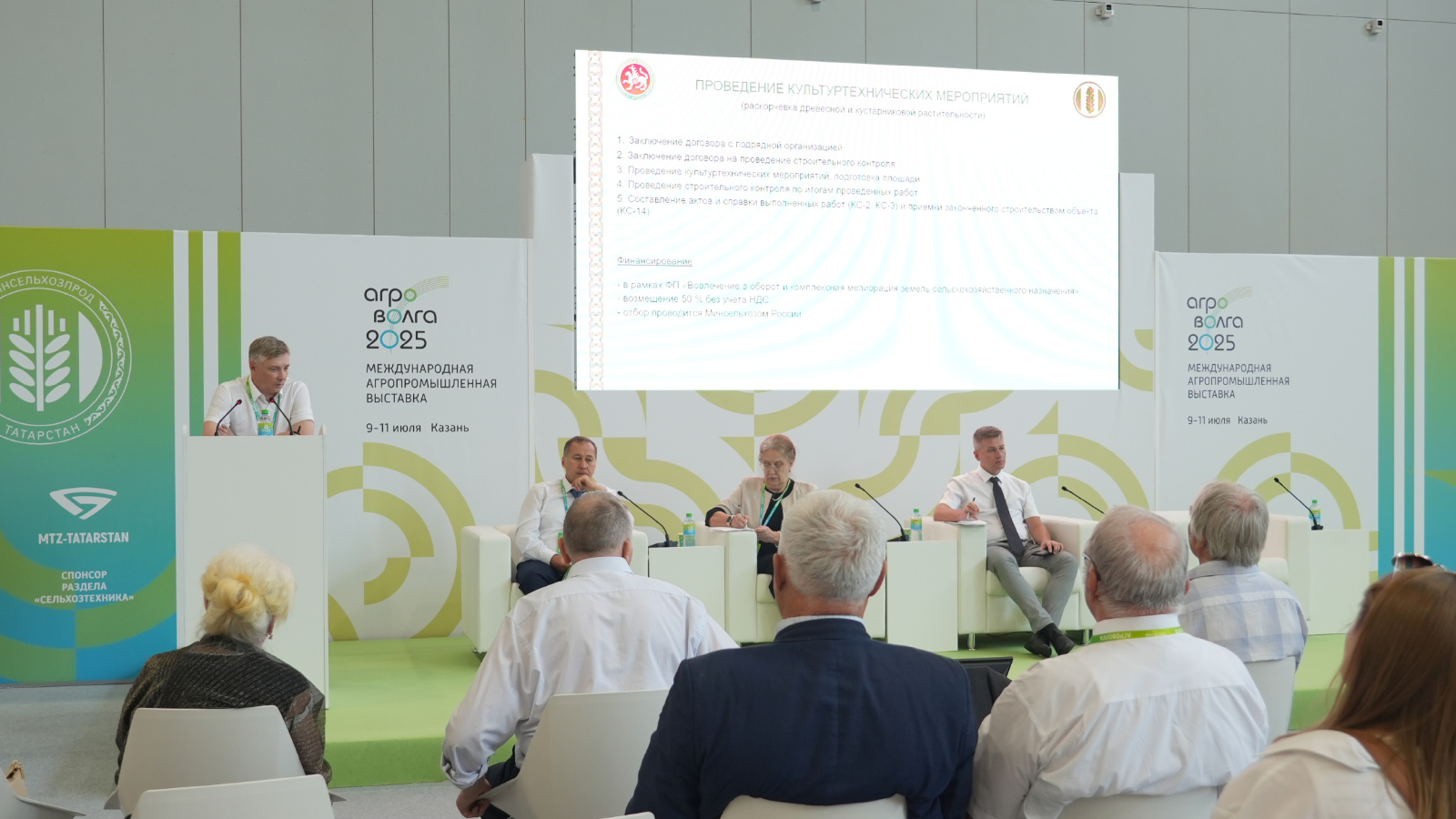
Today, as part of the international agro-industrial exhibition Agrovolga-2025, a round table was held on "Melioration as a factor in increasing the efficiency of agricultural production: modern technologies and best practices". The meeting was moderated by Dmitry Yashin, Deputy Minister of Agriculture and Food of the Republic of Tatarstan.
Director of the Federal State Budgetary Institution "Department of Land Reclamation and Agricultural Water Supply in the Republic of Tatarstan" Mars Khismatullin emphasized that Tatarstan has a republican program that subsidizes 70% of the costs of melioration equipment. At the same time, the agricultural producer pays only 30%.
"The agricultural producer receives a subsidy, and after 10 days, sprinkler machines are already working in the fields. I urge you to take advantage of this opportunity. Our water resources allow us to develop irrigation on an area of more than 400 thousand hectares. The potential of water resources allows us to introduce much more area for irrigation, and state support allows us to significantly reduce the financial burden on our agricultural producers," he noted.
Vice President of the National Committee for Irrigation and Drainage Irina Bondarik spoke about the concept of developing precision melioration in the context of climate change. She noted that in order to create precision melioration, it is necessary to develop mobile applications for melioration, agriculture and water management, as well as create elements of precision melioration regulation systems, an intelligent platform, robotic technology, water system monitoring systems and precision melioration development planning systems.
Director of the All-Russian Research Institute of Irrigated Agriculture Andrey Novikov reported on agricultural technologies for irrigated agriculture to increase the sustainability and productivity of agricultural systems in a changing climate. Particular attention was paid to the practical aspects of developing and implementing the structure of sown areas, crop rotation schemes, resource-saving technologies and irrigation methods on irrigated lands with their adaptation to the zone of the Republic of Tatarstan, ensuring highly productive, cost-effective use of reclaimed lands and irrigation water.
Deputy Director of the Raduga Research Institute Gennady Olgarenko spoke on the topic: "Innovations in irrigation of fodder, industrial and grain crops. Economic effect when irrigating agricultural crops." He spoke about the prospects for the sustainable development of land reclamation in Russia: innovative technologies and irrigation techniques for agrobiocenoses.
According to him, the Ministry of Agriculture of Russia is responsible for 38.5 thousand land reclamation structures, including: 31.06 thousand hydraulic structures, including: 280 reservoirs; 2000 regulating hydraulic structures; 200 ponds; 134 river dams; 38.7 thousand km of water supply and discharge channels; 3.2 thousand km of protective dams. There are 1,571 pumping stations and 4.06 thousand km of pipelines.
He attributed the social effect of the economic development of the melioration complex to the increase in the productivity of reclaimed lands and the stability of agricultural production, the production of high-quality products; obtaining additional income; creating a modern infrastructure; increasing employment and living conditions; increasing labor productivity.
Corresponding Member of the Russian Academy of Sciences VNIIMZ - branch of the Federal State Budgetary Scientific Institution Federal Research Center "V.V. Dokuchaev Soil Institute" Dmitry Ivanov spoke about the role of the All-Russian Research Institute of Reclaimed Lands in the development of melioration agriculture. He emphasized that the main areas of scientific and scientific-practical activity of the institute are the study of the spatio-temporal dynamics of the parameters of the components of the humid zone of our country's agrolandscapes and the development of landscape-melioration farming systems.
Dmitry Yashin said that the resources for developing irrigation in the republic are 10 thousand rivers with a length of 21 thousand km and 880 reservoirs. The available water resources will provide irrigation for more than 400 thousand hectares of land.
According to him, in order to launch a melioration facility from scratch, it is necessary to develop design and estimate documentation for the development of irrigation, obtain state expertise of design documentation and engineering surveys, carry out construction and installation work, and then equip the melioration facility with irrigation equipment.
Special attention was also paid to issues of modern sprinkler machines, innovative solutions for automation and control of irrigation systems, irrigation technologies taking into account soil moisture and modern and new technologies in irrigated agriculture.