A chairman of the Iskra collective farm of Agryz district, who fought on the Trans-Baikal and First Belorussian fronts
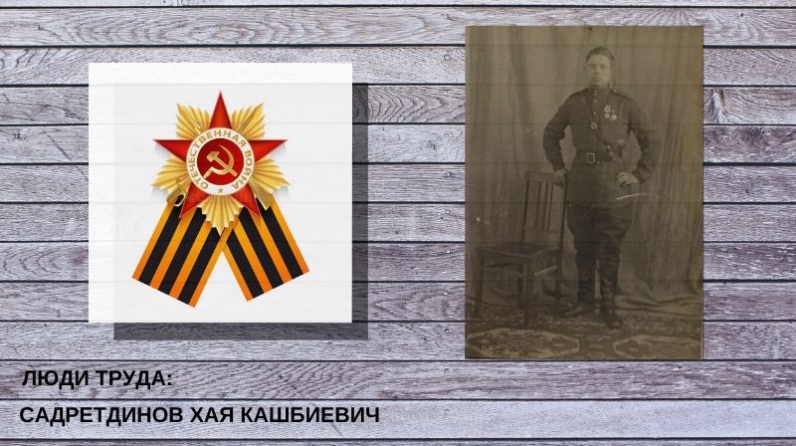
On the eve of the 75th anniversary of the Victory in our section “People of Labor” we talk about agricultural workers - participants of the Great Patriotic War. One of these is Khaya Kashbievich Sadretdinov.
He was born on June 22, 1925 in the village of Bikbulovo of the Menzelinsky district of the TASSR. Here he graduated from 7 classes of the school.
In 1941, he was taken to enter the school for factory apprenticeship and moved to Buryat-Mongolia. But by the way to the station, Levitan's voice was heard and the school turned into a front.
An ordinary signalman of the 55th communications regiment of the 36th army, a participant in the Trans-Baikal and First Belorussian fronts, made all the war. After the capture of Koenigsberg, fearing the possible entry into the world massacre of Japan, the military unit where he served was thrown to the East. Soon they returned to the Transbaikal Front. In May 1945, they were unloaded at the Harapor station. For three months, soldiers marched along the Chinese border. It was the hardest three-month march - with battles and continuous fire. In August 1945, the unit forced the Argun to take Manchu Hailar on the move.
- I will never forget how we took the mountains of Khingan. We, the signalmen, had horses with carts, where we put numerous communications equipment - wires, walkie-talkies, devices: it was clear to everyone that it would be impossible to approach vehicles in the mountains. However, having overcome the foot of the ridge, we also had to abandon the carts, putting the equipment on horsebacks. And approximately in the middle of the road we began to descend, fall into the abyss and horses. Then, having left the horses, we transferred the load into our own shoulders and moved on. And all that - under targeted fire, under the cannonade. Knowing in detail about the Suvorov heroic passage through the Alps, I am sure that our Khingan crossing was no easier. No, it’s not easier ... ”, Khaya Kashbievich remembers.
After the war, Khaya began his career in Agryz district, where he worked as chairman of the Iskra collective farm. For good work, namely, for the complete electrification of two villages and the real water supply to the homes of all his collective farmers, as well as the first of the chairman to install water towers, he received the Order of the Badge of Honor. For all the time of his labor activity, he managed to master the work of a supplier of the construction and installation department and director of the grain preparation center. Upon retiring, Khaya Kashbievich did not sit still for a day, working as a manager and driver in the House of Culture.