Marat Zyabbarov: Field Day in Tatarstan will be held from July 2 to 4, 2020 in the open air
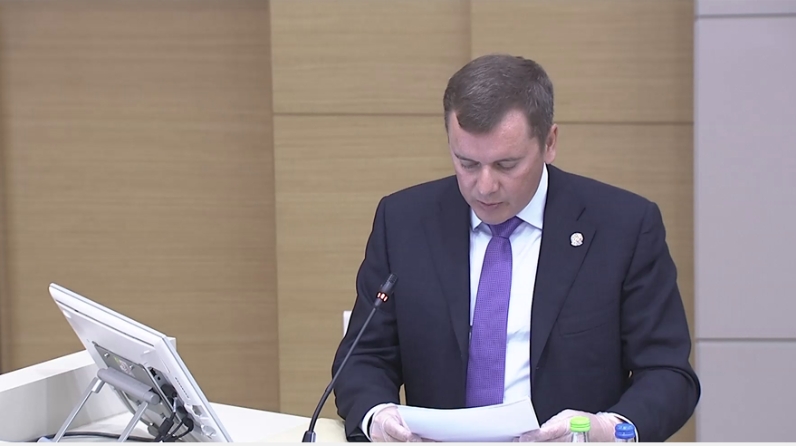
The Deputy Prime Minister of the Republic of Tatarstan, Minister of Agriculture and Food of the Republic of Tatarstan, Marat Zyabbarov reported on the effectiveness of the use of arable land in the Republic of Tatarstan today at a meeting in the Government House. He reminded that "the effectiveness of the agro-industrial complex of the republic directly depends on the results of the work of the crop and livestock industries."
Tatarstan President Rustam Minnikhanov held a videoconference with all municipal areas. The meeting was attended by the Prime Minister of the Republic of Tatarstan Alexey Pesoshin.
Marat Zyabbarov reminded that within the State Program, agriculture indicators for 2020 have been identified. This is the gross harvest of grain crops - 4.1 million tons, oilseeds - 286 thousand tons, potatoes - 1.1 million tons. For these indicators the agribusiness sector received substantial state support in the amount of 3.7 billion rubles.
“To achieve these goals, it is necessary to maintain all sown areas at the level of previous years - 2.8 million hectares, including the area of grain - not less than 1.5 million hectares. We managed to save them this year too, now we are working to increase the return on land”, Marat Zyabbarov said.
The head of the Ministry of Agriculture of the Republic of Tatarstan noted that today in the republic about 2% of arable land is not used. This is mainly in areas adjacent to Kazan. “Together with the heads of municipal districts, we are working to involve these problematic lands into process. We hope to get certain results by autumn, ”he said.
This year, two directions are emphasized in the republic: soil revitalization through its deoxidation (liming program) and management of the crop formation process.
In the republic, due to the high proportion of acidic soils (42%), arable land does not give the expected results. For the current year, the liming indicator is 80 thousand ha, there is an 40% increase compared to last year.
Speaking about the process of maximum deoxidation of the soil, Marat Zyabbarov noted: this year at least 80% of the costs will be reimbursed from the regional and federal budgets. The federal program in this direction will work until 2024.
The districts, having a large proportion of acidic soils, plan liming of non-essential areas: for example, the Nizhnekamsk region has 60% acidic soils, but it plans to calcify only 2.3% of them. Marat Zyabbarov recommended to pay attention to this issue and assign a responsible specialist to control the areas.
Harvesting at the proper technological level is impossible without stationary mortar units. “We set ourselves the task - to create about 500 mortar units in farms with arable land processing over 500 hectares so that every ton of water going into the field undergoes appropriate preparation,” said the head of the Ministry of Agriculture of the Republic of Tatarstan.
Today, almost half of the republic's farms have solved this problem. The Atninsky, Menzelinsky, Kukmorsky, Aksubaevsky, Baltasinsky, Kaybitsky and Sabinsky areas are between them. Among the investment companies there are Tatagroleasing JSC, AgroInvest JSC, Ak Bars Holding Company JSC, August-Muslum LLC.
At the same time, in Almetyevsk, Bugulminsky, Zelenodolsky, Mendeleyevsky districts there is not a single normally functioning mortar unit.
“The full-fledged work of these units seriously improves not only the quality of protective measures, but also gives serious savings in drugs. Who has not built it so far - lost a year. We hope that the districts will install mortar assemblies in order to start using them in the spring of next year, ”said Marat Zyabbarov.
At the end of his speech, the Minister invited agrarians to the agricultural exhibition “Field Day in Tatarstan - 2020”. The event will be held from July 2 to 4, 2020 in the Laishevsky municipal district. The exhibition will feature about 100 new promising varieties and hybrids of agricultural crops, the advanced achievements of the agricultural industry. The purpose of the event is to study advanced scientific achievements in the industry, strengthen business ties between farmers and establish contacts between manufacturers and suppliers of equipment.